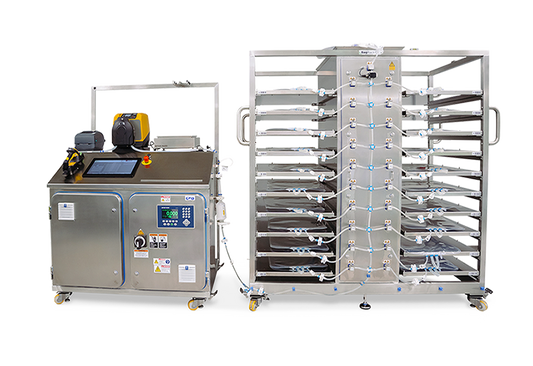
RoSS.FILL Bag is a flexible automated aseptic filling machine for the aliquotation and dispensing of bulk drug substance (BDS) into single-use bags. The system for aseptic filling and sterile filtration is highly precise, making RoSS.FILL Bag an e...
As an expert in single-use solutions, we have made it our goal to deliver vendor agnostic single-use assemblies manufactured at highest quality standards in ISO 7 cleanrooms and sterilized within shortest lead times. Prevent downtime and ensure an...
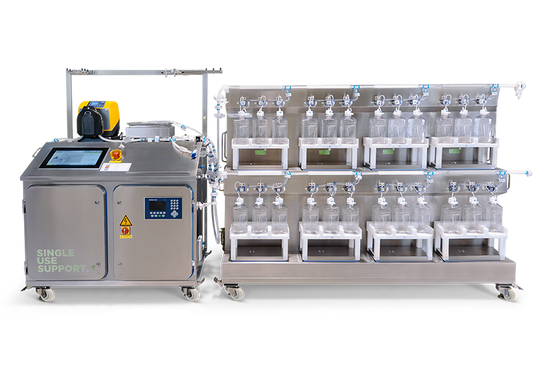
The fully automated RoSS.FILL aseptic single-use bottle filling system enables worry-free filling and filtration of your liquid drug and non-drug substances into bottles. With highest filling accuracy, the single use filling system provides closed...
The safest transport solution for all available single-use bioprocess containers. Protect your single-use bag and reduce product loss. RoSS®: Robust Storage & Shipping
Speed to market, flexibility, and process efficiency are more important than ever in biopharmaceutical production. Single-use systems support novel approaches to aseptic fluid management and aseptic liquid transfer. However, regarding the sustainability of single-use systems, there are still concerns within the scientific community. BioPharm International sat down with Single Use Support to address these apprehensions and discuss the future of single-use systems in biopharma.
Single-use systems in biopharma: would you see it as the rising trend or a short-term buzz?
We would see it as the rising trend, meaning a long-term trend. Different customers have different requirements regarding their processes in terms of scalability and primary packaging in the variety of products. As a company, we see more and more customers focus on sustainability topics like energy consumption and waste material. When we hear clients talking about problems and requirements, single-use technologies meet their requirements. Cell and gene therapies have an influence on the trend of single-use technologies - where short turnaround times are crucial - as well as highly-adaptive systems to different demands in equipment. For example, one of our clients has a huge manufacturing facility where only stainless-steel tanks are connected with single-use equipment. This enables agility in a facility, even if stainless-steel tanks are still used. This means that this setup requires a variety of single-use assemblies to meet the demands of different processes instead of building a new facility fully made of stainless steel. For example, another client goes even further by replacing the stainless-steel tanks with single-use bioreactor bags, meaning those bags include the complete sensor technology for process monitoring. So, to sum it up, there’s definitely a trend toward single-use equipment.
What are the key benefits of single-use systems over stainless steel?
Single-use systems can be disposed immediately after their utilization, as they do not require any elaborate cleaning and disinfection (CIP, SIP). It takes eight months less project lead time for implementation of single-use production. So, single-use systems are much more flexible and scalable, as well as suitable for small and large amounts of drug substances. When we compare single-use systems to stainless-steel facilities, the complexity of automatization is markedly higher. Complex steps like cleaning and validation take a lot of time between separate production steps. Plus, non-disposable liquid pathways make installation more elaborate. Stainless-steel processes also require a significant amount of infrastructure for processing and cleaning on site.
Another factor I would like to point out is safety. With the disposal of the liquid pathway after each batch, single-use technologies overcome risks of cross contamination. In terms of stainless steel, the risk of contamination is particularly high in different antibodies, if proteins are manufactured in the same facility. Contamination leads to a loss of drug substance and requires additional cleaning steps. Another crucial factor for the key benefits is cost efficiency. Single-use systems reduce initial investment as well as R&D costs. The initial investment costs are approximately 40% lower than the price for a comparable stainlesssteel facility. So, compared to stainless-steel bioreactor systems, they have high costs for complex production stages like cleaning and sterilization. Furthermore, costs for implementation, utility, and maintenance are comparatively high. Another factor is the operational expenditures, which are decreased due to the efficient use of time and resources, especially regarding cleaning-in-place and steaming-in-place procedures and/or relevant supportive actions and resources, meaning human capital.
Sterile Consumables and Non-sterile Consumables
How would you assess the risks of cross contamination comparing single-use systems with stainless steel?
While talking about single-use systems, you can’t talk about a closed system without any potential contact to the environment. The entire single-use system is sterilized under validated conditions and, compared to stainless-steel parts, all parts are touched. It means knowing eventually that volumes are there, which might be a source of contamination. That liquid transfer can be done in a whole closed system with different technologies - sterile connectors, single-use filters, pressure sensors, flow meters, and many more - without cleaning. The different parts of the single-use assembly already come sterilized and double packaged to the customer and are ready to use. Operators only need to click different parts together and then the sterile system is good to go. There is no need to wait on results of different departments of the company, like the microbiology lab of quality, which can take hours to days before it can start production. Furthermore, a huge volume of water for injection (WFI) needs to be used to rinse the stainless-steel system.
Increasingly interesting for the industry are sustainable solutions. How sustainable are single-use systems?
Single-use technology used in biopharma produces about only 0.01% of the total plastic waste. End-to-end life is rigorously collected, decontaminated, and treated. That’s one crucial point for the sustainability aspect of single-use systems. Furthermore, materials used in single-use equipment follows very high regulation standards with different kinds of certificates and studies, for example, extractables and leachable studies, REACH, certificates, including BSE, TSE, Bis-Phenol-A, phthalates, melamine, dioxin, and many more. Compared to stainless steel, you’re safe. Heat, water, chemicals - so meaning the whole energy management and waste management - is completely different from the conventional and traditional stainless-steel systems. The single-use technology also saves electricity due to reduced size and classification of controlled areas. To sum it up, the average reduction of the carbon footprint, including the reduction of water, energy, chemicals, etc., is 40% compared to stainless steel, which is huge.
Looking into the future, could single-use systems completely replace stainless steel?
We would say not completely, but to a large extent. Possibly up to 90%, but with time passing by and more and more users switching to single-use systems, technologies will definitely be developed further, and a lot of today’s challenges will be solved. The main disadvantage of switching from stainless steel to single-use systems is scalability. Scales are limited by current 2,000 L cell culture bioreactor capacities. However, some of our customers split up, for example, a 12,000 L vessel into 2,000 L single-use bioreactor bags and, therefore, they are able to harvest continuously. With this, the customer converted the disadvantage to an advantage in terms of dynamic harvesting. The technical term is continuous harvesting. Single-use systems have become increasingly popular over the past few years, and they are now an established standard in the biopharmaceutical industry.
As mentioned before, there are a few advantages compared to the traditional stainless-steel reactors. You can raise the question: why are some manufacturers still hesitant when it comes to switching from stainless steel to single use? Stainless-steel tanks, as single-use bags protection, pose no such risk. On the other hand, the contamination rate is substantially higher. Additionally, cleaning and sterilization can be an issue. The same is true for wrongly positioned seals or liquid pathways. However, new developments should never be ignored; after all, new technologies that allow for a more effective production process are key to staying competitive. Single-use systems offer biopharmaceutical companies a new and reliable logistics process for liquids on the basis of standardized single-use bags. Therefore, we strive to fulfill the requirements of our customers in that sector. Such demand can only be met by applying single use-technologies.
Fluid Management Solutions around Single-Use Technologies
[[download-1]]
Aseptic filling, a critical process in pharmaceutical manufacturing, ensures the sterility of large-volume drug substances, safeguarding their efficacy and safety. Thus, this method plays an indispensable role in maintaining product integrity.
In this article, we will highlight essential aspects of aseptic filling of drug substance, outlining its step-by-step procedure and exploring its applications across diverse pharmaceutical sectors.
Fluid management solutions by Single Use Support
[[ToC]]
What is aseptic filling?
Aseptic filling is a crucial process within pharmaceutical manufacturing that ensures the sterility of drug substances during their transfer into containers in different formats and sizes. It prevents contamination by germs, maintaining the purity and efficacy of the product.
Aseptic filling involves a carefully controlled environment where both the product and the surroundings remain free from any microbial contamination throughout the filling process. Aseptic filling techniques are designed to uphold the integrity of the drug substance, crucial for products like injectables, biologics, and other sensitive pharmaceuticals as well as their individual components.
In which areas is aseptic filling necessary?
Aseptic filling becomes necessary for certain drug products that cannot undergo terminal sterilization methods like exposure to high heat, as they are too sensitive and complex to withstand such procedures. It is therefore necessary to create a germ-free environment in which these products can be processed, preventing them from being contaminated at any production step and thus bypassing the need for terminal sterilization of the substance.[[1]]
Examples of pharmaceutical products that necessitate aseptic filling include several injectable medications, biologics (such as mRNA vaccines, antibodies, and cell therapies), and certain liquid formulations of medications. These substances are often sensitive to heat or other sterilization methods and must maintain their effectiveness without compromising patient safety.
Moreover, aseptic filling is indispensable in producing drug products intended for injection into the bloodstream or sterile body cavities. This way of administration circumvents natural defense systems like skin or mucous membranes – contaminated drug substances could pose severe health risks to patients. Consequently, maintaining aseptic conditions during the filling process ensures that these medications remain free from harmful microorganisms, preserving their therapeutic value and patient safety.
Aseptic filling of large volumes – step by step
In order to ensure a flawless aseptic filling process of large volumes, pharmaceutical manufacturers adhere to a set of process steps that many applications correspond in:
Preparation phase
The aseptic filling process commences with meticulous preparation. This involves ensuring the cleanliness and sterility of the entire environment, including equipment, surfaces, and personnel attire.
Fluid preparation
The drug substance undergoes preparation, potentially involving filtration and homogenization, to achieve the desired purity and uniformity.
System setup
Fluid management systems are readied for use. These automated systems offer fully controlled fluid paths, ensuring a sterile environment throughout the process.
Filling stage
The prepared drug substance is fed into the aseptic filling machine, such as the RoSS.FILL system. The platform's automation facilitates precise and sterile filling into single-use bags or bottles.
Filtration (if applicable)
Depending on the substance and process requirements, a filtration step might be integrated into the filling process. This step ensures the removal of particulates or microbes that could compromise product integrity.
Packaging and sealing
Once verified, the filled drug substance is sealed into containers or bottles within the closed system. This process is crucial to maintain the sterility and integrity of the product until use.
Post-filling verification
Post-filling, thorough verification processes are undertaken. These include checks for accuracy, sterility, and overall product quality to adhere to stringent regulatory standards.
Clean-up and sanitization
Following the filling process, the used equipment must either be prepared for subsequent following cycles or, in the case of single-use consumables, dissembled and disposed. Relying on single-use technologies can significantly reduce the need for laborious cleaning and sterilization steps at the manufacturing site.
Techniques to ensure success in large-scale aseptic filling
Large-scale aseptic filling techniques encompass a range of measures designed to maintain a sterile environment during the transfer of pharmaceutical liquids. Some key techniques involved in aseptic filling include:
Isolators and barrier systems
These closed systems provide a physical barrier between the product and the external environment, preventing microbial ingress. Isolators are used to enclose specific processes or equipment, ensuring aseptic conditions.
Laminar airflow systems
These systems create a continuous flow of filtered air in a unidirectional manner to maintain a clean and sterile environment within the filling area. They minimize the risk of airborne contamination during the filling process.
Sterile barriers and enclosures
Utilizing sterile materials and barriers, such as sterile gloves, gowns, and covers, helps prevent contamination from personnel or the environment.
RABS (Restricted Access Barrier Systems)
Similar to isolators, RABS provide a physical barrier around the filling area, restricting access and minimizing the risk of contamination.
Automated filling equipment
Automated systems reduce human intervention and the potential for contamination. These machines are designed to fill containers while maintaining aseptic conditions, minimizing the risk of microbial ingress.
Challenges when filling bulk drug substance
In fluid management for large volumes, several challenges demand attention:
Complexity of scale: Handling larger volumes poses logistical challenges, requiring specialized equipment and infrastructure to maintain aseptic conditions uniformly across the entire volume.
Sterility maintenance: Ensuring sterility throughout the entire process becomes more challenging with larger volumes, as any contamination can significantly impact a larger quantity of product.
Time sensitivity: Large-volume aseptic filling often requires swift processing to minimize exposure, which can pose challenges in maintaining aseptic conditions while meeting production speed demands.
Equipment compatibility: Compatibility between equipment and the properties of larger volumes of drug substances can present technical challenges, requiring specialized machinery and processes.
Validation and documentation: Validating and documenting aseptic processes for large volumes requires meticulous attention to detail to ensure compliance with regulatory standards.
Demand for highest precision: Managing larger volumes requires precise control to ensure accurate dosing and uniform distribution throughout the volume, demanding advanced technologies and methods to maintain precision at scale.
Product sensitivity: Certain drug substances, such as many biologics, can be highly sensitive to environmental conditions, temperature fluctuations, or prolonged exposure to air, intensifying the need for meticulous handling.
Regulatory compliance
Achieving regulatory compliance in aseptic fluid management involves adhering to stringent guidelines aimed at ensuring the safety and efficacy of pharmaceutical products. This necessitates a very general yet elaborate approach:
Implementing Good Manufacturing Practices (GMP) involves meticulous record-keeping and a robust quality management system. Developing and rigorously validating protocols specific to large-volume fluid management is essential, encompassing equipment, processes, and aseptic techniques to meet regulatory expectations.
Establishing a comprehensive environmental monitoring program is crucial for continuous assessment of air quality, surface cleanliness, and microbial levels within controlled environments. Timely resolution of any deviations identified during monitoring is vital to uphold compliance with regulatory standards.
Regular review and adjustment of procedures are necessary to align with evolving regulatory requirements, ensuring continuous adherence to aseptic guidelines and standards.
Source: FDA[[3]]
What’s needed for successful aseptic fluid management?
Successful aseptic fluid management requires a combination of strategic elements to ensure the integrity and sterility of pharmaceutical products. Key components for success include:
Rigorous training programs
Robust quality control measures
Failsafe processes
State-of-the-art equipment
Let’s take a closer look at some of these aspects.
Source: Aspen Survey[[4]]
Rigorous training programs
Fluid management solutions have become far more intuitive and support staff during sensitive procedures. User-friendly interfaces, failsafe interconnections and implemented integrity control measures facilitate the operation of these machines.
However, a great deal of responsibility remains with the operators of fluid management systems, the expertise of whom is required, for instance, when production lines are being altered, or when malfunctions have to be detected and corrected. Additionally, awareness of the characteristics of processed substances is required, just like general knowledge on pharmaceutical liquid processing.
Consequently, rigorous training programs for scientific staff in liquid management are required that not only cover this area in general. It is equally important to mediate the necessary know-how on individual fluid management platforms and processes.
Quality control tests
The integrity of fluid management processes, systems, equipment, and ultimately the processed pharmaceutical product is to be maintained and monitored. For that end, quality control tests are implemented to ensure product safety and effectiveness.
Notably, it is not enough to validate the quality of the final product at the end of a production cycle. Large amounts of potentially faulty batches might have been produced in the meantime due to an undetected deviation in the fluid management process.
Reasonably, individual components have to be tested in order to ensure their integrity when being implemented into fluid management systems. This applies to components like optional filters, which is why pre-use post sterilization integrity testing (PUPSIT) is often performed to guarantee that these filters meet the high standards in aseptic fluid management.
Failsafe, automated fluid management processes
Ensuring failsafe fluid management in aseptic environments requires diligent planning and execution of meticulously designed processes. For that purpose, detailed procedures and standardized protocols provide precision in upholding aseptic principles. This is further facilitated by automation, including robotics, which reduces human intervention and ensures consistency and sterility while minimizing the risk of contamination.
Closed systems and as well as end-to-end solutions physically prevent environmental contaminants. Continuous monitoring, enabled by sophisticated systems, tracks critical parameters for real-time detection of deviations, allowing immediate corrective actions.
Another key element in pharmacovigilance is validation, along with precise documentation to ensure consistent adherence to predetermined standards. Yet again, automation can help to uphold quality standards, streamlining operations, and upholding stringent aseptic conditions in fluid management workflows.
Adequate materials for tubing solutions and other components
Aseptic production demands material that adhere to strict criteria to uphold sterility and product integrity. These components must demonstrate minimal permeability to prevent contaminants or gases from compromising the product. Additionally, they should exhibit low extractables profiles to minimize any potential leaching of substances that could affect product safety.
Materials such as stainless steel, glass, or specialty polymers are often used for reusable systems. They allow maintaining aseptic conditions while providing enhanced durability. However, due to factors like increased flexibility, biopharma companies are increasingly implementing single-use technologies in their fluid management processes. And as the filling approach evolves, so do the required materials.
As for single-use tubing assemblies, for instance, commonly used materials include silicone and thermoplastic elastomers (TPE). These materials are favored for their flexibility, resilience, and suitability for single-use applications. Silicone, known for its biocompatibility and inertness, along with TPEs, offers excellent chemical resistance and low extractables, making them ideal for maintaining aseptic conditions in tubing solutions while ensuring the safety and quality of pharmaceutical products.
However, all the involved components, including materials chosen for containers, closures, and packaging undergo rigorous evaluation to meet stringent criteria for sterility, durability, and compatibility with pharmaceutical products.
Dedicated aseptic filling machines and additional assemblies
Dedicated aseptic filling machines and complementary assemblies play a pivotal role in aseptic fluid management. These modular fluid management solutions precisely dispense the prepared fluid into containers – but there is more to it.
Filtration steps are essential for many products, ensuring the removal of particulates and microbes from the fluid. However, the need for separate filtration machines is often circumvented by the direct implementation of filtration technologies into filling platforms.
Additionally, modular fluid management systems allow the integration of homogenization machines, crucial for kneading components in order to ensure uniform, consistent product quality. These machines work in tandem, preparing the fluid for filling by achieving the required purity and uniformity.
The interplay between filtration, homogenization, and filling machines is critical. Filtration primes the fluid by removing impurities, homogenization guarantees uniformity, prior to aseptic filling into sterile containers.
[[download-1-email-detailed]]
Filling machines for large volumes based on single-use technologies
Within the RoSS.FILL platform for automated fluid management, Single Use Support has integrated dedicated solutions for aseptic filling of large volumes.
In aseptic large volume drug filling, Single Use Support stands at the forefront, providing innovative solutions that redefine pharmaceutical processes. Among these advancements is the RoSS.FILL system, a fully automated single-use filling and filtration platform. Offering scalability and adaptability, RoSS.FILL transforms aseptic filling and draining processes, accommodating a diverse range of consumables and manifold systems for unparalleled flexibility.
Further complementing Single Use Support's portfolio are the RoSS.FILL Bag and Bottle systems. RoSS.FILL Bag provides a flexible solution for aseptic bag filling, ensuring sterile connections and a fully disposable fluid path. On the other hand, RoSS.FILL Bottle offers efficient filling and filtration of liquid drugs into bottles, maintaining high accuracy within a closed system.
Additionally, the RoSS.PADL platform focuses on homogenization, gently massaging single-use bags while cooling to ensure a homogenous mixture of solutions. Simultaneously, the RoSS.DRAI system facilitates controlled fluid flow during the draining process, minimizing holdup volumes and enabling continuous pooling.
Innovatively integrating supplier-independent filters into the RoSS.FILL platform enhances the speed and reliability of bulk drug substance production, optionally with the possibility for PUPSIT (pre-use post sterilization integrity testing) to ensure filter integrity. This interplay further extends the range of sterile compound and segregation options, responding to the demands of the fast-paced pharmaceutical industry.
Single Use Support's fluid management systems redefine aseptic large volume drug filling, emphasizing automation, scalability, and speed. These solutions represent a commitment to advancing pharmaceutical logistics, ensuring sterility, and meeting the evolving demands of the industry.
Aseptic large volume drug filling with single-use technologies
In aseptic large volume drug filling, Single Use Support stands at the forefront, providing innovative solutions that redefine pharmaceutical processes. Among these advancements is the RoSS.FILL system, a fully automated single-use filling and filtration platform. Offering scalability and adaptability, RoSS.FILL transforms aseptic filling and draining processes, accommodating a diverse range of consumables and manifold systems for unparalleled flexibility.
Further complementing Single Use Support's portfolio are the RoSS.FILL Bag and Bottle systems. RoSS.FILL Bag provides a flexible solution for aseptic bag filling, ensuring sterile connections and a fully disposable fluid path. On the other hand, RoSS.FILL Bottle offers efficient filling and filtration of liquid drugs into bottles, maintaining high accuracy within a closed system.
Additionally, the RoSS.PADL platform focuses on homogenization, gently massaging single-use bags while cooling to ensure a homogenous mixture of solutions. Simultaneously, the RoSS.DRAI system facilitates controlled fluid flow during the draining process, minimizing holdup volumes and enabling continuous pooling.
Innovatively integrating supplier-independent filters into the RoSS.FILL platform enhances the speed and reliability of bulk drug substance production, optionally with the possibility for PUPSIT (pre-use post sterilization integrity testing) to ensure filter integrity. This interplay further extends the range of sterile compound and segregation options, responding to the demands of the fast-paced pharmaceutical industry.
Single Use Support's fluid management systems redefine aseptic large volume drug filling, emphasizing automation, scalability, and speed. These solutions represent a commitment to advancing pharmaceutical logistics, ensuring sterility, and meeting the evolving demands of the industry.
Fluid management of large volumes with Single Use Support
References
The Basics of Aseptic Processing, https://www.pharmtech.com/view/the-basics-of-aseptic-processing, Published 2021
Aseptic Processing: A Primer, https://www.biopharminternational.com/view/aseptic-processing-primer, Published 2013
Guidance for Industry Sterile Drug Products Produced by Aseptic Processing — Current Good Manufacturing Practice, https://www.fda.gov/media/71026/download, Published 2004
Aspen Survey: Which of the following represents the greatest challenges to your process? ASQ 1282 2023 121123, Published 2023
GMP Annex 1, the European guideline for “Manufacture of sterile medicinal products”, has been updated in 2023. The revision’s changes have added several challenges, but also chances for manufacturers in order to comply with the new regulations.
This article aims to provide an overview of Annex 1, its applicability, and the necessary actions that biopharma industry stakeholders must take to comply with its requirements, particularly in relation to single-use assemblies.
[[ToC]]
What is Annex 1?
Annex 1 is the European Union’s guidelines for the manufacturing of sterile medicinal products. The original draft of Annex 1, also known as “EU GMP Annex 1: Manufacture of sterile medicinal products”, from 1971, was expanded and updated in August 2022. It came into effect on August, 25 2023.
EU GMP Annex 1 outlines the GMP-specific requirements (Good manufacturing practice) needed to ensure product quality and patient safety when it comes to sterile medicinal products. The guidelines were not only directed at pharmaceutical manufacturers, but also towards partnerships between contract manufacturing organizations and their clients. [[1]]
Annex 1: Requirements for pharmaceutical manufacturing
GMP Annex 1, also known as the "Manufacture of Sterile Medicinal Products," is a guideline published by regulatory authorities, such as the European Medicines Agency (EMA) and the U.S. Food and Drug Administration (FDA). It outlines the principles and practices for the manufacture of sterile medicinal products to ensure their safety, efficacy, and quality as laid down in Commission Directive (EU) 2017/1572 for medical products for human use and veterinary use.
GMP Annex 1 applies to pharmaceutical manufacturers, contract manufacturing organizations (CMOs), and other entities involved in the production of sterile medicinal products. It is applicable to a wide range of biopharmaceutical processes, including fluid management, where single-use assemblies are commonly employed.
In the past, individual components for advanced therapy medicinal products, like mRNA or viral vectors, were filtered aseptically and then filled into sterile components with a large share of manual handling (e.g. in laminar air flow or filling lines). Now, there is a greater focus on automated processes and closed systems. [[2]]
Manufacturers and industry professionals must assess the quality, performance, and suitability of single-use systems to meet the specified requirements. [[2]]
Single Use Support aiding in Annex 1 compliance
EU Annex 1 and the changes in 2023
Annex 1 is the European GMP guide, while the American equivalent by the FDA is titled “Guidance for industry: Sterile drug products produced by aseptic processing current good manufacturing practice”. [[3]] In China, the National Medical Products Administration (NMPA) has issued equivalent regulations under the “Good Manufacturing Practice for Drugs”. [[4]]
The first version of Annex 1 was published in 1971. Since then, the document experienced several adaptations, but a complete revision process was only started in 2012.
For the revision, the EU commission worked closely together with the World Health Organization (WHO), the Pharmaceutical Inspection Co-operation scheme (PIC/S) and the Food and Drug Administration (FDA). [[5]] One of the goals was to achieve a more unified version of guidelines for the manufacturing of sterile medicinal products.
The aim of the mission was to react to new changes in manufacturing environments, which is mirrored by the strong focus of the guidelines on contamination risk management. [[3]] [[4]] [[5]]
Content of Annex 1 – the main focus areas
The main focus areas of Annex 1 include the application of Quality Risk Management (QRM). [[6]] Manufacturers are required to implement a Contamination Control Strategy (CCS), include the Pharmaceutical Quality System (PQS) into their manufacturing process, and apply the principles of QRM (monitoring, disinfection and staff training).
Next to updated cleanroom requirements [[7]], Annex 1 determines regulations for Pre Use Post Sterilization Testings (PUPSIT) for filters used in bioprocessing. [[8]]
Further, a new set of technologies is addressed in Annex 1, ranging from restricted access systems (RABS) for cleanrooms to isolators and single-use technologies. [[6]] [[7]] [[8]]
Risk management and contamination control strategies
The revision of Annex 1 has a main focus on the aspects of Quality Risk Management and the development of Contamination Control Strategies for pharmaceutical manufacturers. CCS strategies are laid out as a “set of controls for microorganisms, endotoxin/pyrogen and particles, derived from current product and process understanding that ensures process performance and product quality.” [[7]]
As the revised guidelines aim for improved quality, safety, and overall-contaminant-free products, manufacturers have to come up with strategies to achieve this. These include regular controls of risk factors to cleanroom environments, such as raw materials, excipient and drug product components, as well as facility and equipment design. Further, thorough documentation of the whole process from design to the administration of the product has to be provided in order to comply with Annex 1. [[9]]
Cleanroom regulations
In Annex 1, cleanrooms experience a heightened amount of attention. The most striking changes involve regulations on how to move within cleanrooms (slow and controlled movements, so not to shed more particles than needed), as well as specially designed clothing items.
The rules laid out for the different cleanroom classes from A to D can differ. While hair, for example, does not need to be covered in Grade A and B environments, members of staff need to wear a cap and cover beards and jewellery in C and D environments.
Further, it is laid out how technologies for cleanrooms like Restricted Barrier Access Systems (RABs) require special testing and control strategies. The integration of automated systems helps manufacturers reach GMP requirements more easily. Closed processes prevent exposure times and help to maintain sterility by reducing the need for manual intervention.
PUPSIT: Pre-Use Post Sterilization Integrity Test
PUPSIT is the abbreviation of Pre Use Post Sterilization Integrity Testing. The process helps pharmaceutical manufacturers to make sure that a filter is fully functional before it is used in bioprocessing.
Before a membrane filter, for instance, can be used in a bioreactor, the filter has to be sterilized. After that, testing is performed to verify the filter’s integrity, meaning it has not been damaged during sterilization.
The most widely used filter integrity testing method is the Bubble Point Test, during which water is injected to moisten the filter. The test depends on sterile filter test tubes, which are often made out of stainless steel. However, the use of single-use-technologies is on the rise. With single-use filtration assemblies, the whole system, and not just the filter, is replaced after every cycle. They eliminate the need for autoclaving procedures and help guarantee that the drug formulations are not diluted by water residues after filter testing.
Annex 1 and the PUPSIT requirement
The role of single-use technologies in complying with Annex 1
Single-use technologies are increasingly used on production lines and could help to ensure compliance. For example, single-use bioprocess containers make it easier to maintain sterility across powder and liquid transfers or open handling by manual filling. Single use systems should be designed to reduce the need for manipulations and complexity of manual interventions. (8.132 of Annex 1). In detail this includes
the interaction between the product and product contact surface (such as adsorption, or leachables and extractables)
the fragile nature of the system compared with fixed reusable systems
the performance of the pre- and post-use integrity testing for sterilizing grade filters
the risk of holes and leakage
the potential for compromising the system at the point of opening the outer packaging and
the risk of particle contamination
Single Use Support can provide customers with documentation, risk assessments and product specified information, such as data for extractables and leachables of single-use systems, proving how the company fulfills the criteria with its solutions.
GMP Annex 1 significantly impacts the use of single-use assemblies in fluid management processes within the biopharmaceutical industry. It requires manufacturers and stakeholders to adopt a risk-based approach, implement proper controls, and ensure the integrity and sterility of single-use systems. Compliance with GMP Annex 1 is essential to maintain product quality, meet regulatory requirements, and safeguard patient safety.
[[download-1]]
Single Use Support aiding in Annex 1 compliance
Adopting the necessary changes to comply with Annex 1 sets a challenge for many manufacturers of biologic drugs. Defining the scope of a CCS can be a great difficulty because Annex 1 guidelines do not only include the products and components on-site, but also starting materials and other products provided by other parties.
With changes in cleanroom regulations and strategies to prevent contamination like regular filter controls, the necessary changes pharmaceutical and biotechnology companies have to make call for holistic solutions.
RoSS.FILL: Filling and filtration system
The advanced filling and filtration system RoSS.FILL can be expanded with a PUPSIT rack for sterile filtration. It was designed by Single Use Support to guarantee alignment with Annex 1 guidelines. This closed automated system offers the benefits of modularity and scalability and is compatible with single-use bioprocessing containers in different sizes to cater to smaller and large-scale productions.
Automated filling and dispensing with Single Use Support
IRIS single-use assemblies
Single Use Support also offers the single-use assemblies needed for GMP-compatible fluid and cold chain management, from tubes to filters for sterile fluid management. With holistic process solutions, the company helps manufacturers achieve the highest product quality and patient safety.
Sterile consumables for biopharma
Conclusion: What Annex 1 means for pharmaceutical manufacturing
GMP Annex 1 significantly impacts the use of single-use assemblies in fluid management processes within the biopharmaceutical industry. It requires manufacturers and stakeholders to adopt a risk-based approach, implement proper controls, and ensure the integrity and sterility of single-use systems. Compliance with GMP Annex 1 is essential to maintain product quality, meet regulatory requirements, and safeguard patient safety.
Single Use Support is pioneering the biopharmaceutical industry and is at the forefront of advancing fluid and cold chain solutions. The process solutions provider takes the same approach as Annex 1, that automated single-use technologies and closed and protected systems help reduce the risk of contamination. As a trusted partner to multiple biopharmaceutical manufacturers and contract development and manufacturing organizations, Single Use Support is here to offer guidance in achieving maximum product quality, patient safety and navigating GMP Annex 1.
Annex 1 compliant solutions
* IRIS Single use systems are developed product-specifically. All filter capsules available on the market can be installed. Filter types are selected depending on product and quantity. Single Use Support takes the recommended redundancy into account. The use of high-pressure resistant material, such as braided silicone (platinum cured) tubing and the interconnection protection with Oetiker clamps enables leakage-free testing of the filter components prior to filtration at high pressures and filtration after testing. The recommended working pressure is determined during development of the assmenly and the feasibility of testing is ensured. The venting and flushing of the system is taken into account in the configuration. Each assemly is a custom solution for the manufacturers process
References
Second targeted stakeholders' consultation on the revision of Annex 1, on manufacturing of sterile medicinal products, of Eudralex volume 4, https://health.ec.europa.eu/consultations/second-targeted-stakeholders-consultation-revision-annex-1-manufacturing-sterile-medicinal-products_en, Published
RNA-based drugs and regulation: Toward a necessary evolution of the definitions issued from the European union legislation, http://dx.doi.org/10.3389/fmed.2022.1012497, Published 2022-10-17
Main Responsibilities of the National Medical Products Administration, https://english.nmpa.gov.cn/2019-07/18/c_377587.htm, Published 07/2019
FDA and EU GMP Annex 1 Differences in Cleanroom Specifications, https://www.raps.org/News-and-Articles/News-Articles/2019/7/FDA-and-EU-GMP-Annex-1-Differences-in-Cleanroom-Sp#citation, Published 07.2019
The Rules Governing Medicinal Products in the European Union Volume 4 EU. Guidelines for Good Manufacturing Practice for Medicinal Products for Human and Veterinary Use, https://health.ec.europa.eu/system/files/2022-08/20220825_gmp-an1_en_0.pdf, Published
ISO 14698 or EN 17141: Is There a Choice for Cleanroom Compliance?, http://dx.doi.org/10.2345/0899-8205-57.s1.15, Published 2023-05-05
Sterilisation Methods, http://dx.doi.org/10.1007/978-3-031-20298-8_30, Published 2023-06-15
Enhancing Compliance with EU GMP Annex 1 Requirements, https://www.americanpharmaceuticalreview.com/Featured-Articles/609715-Enhancing-Compliance-with-EU-GMP-Annex-1-Requirements/, Published 12/2023
The Rules Governing Medicinal Products in the European Union Volume 4 EU. Guidelines for Good Manufacturing Practice for Medicinal Products for Human and Veterinary Use, https://health.ec.europa.eu/system/files/2022-08/20220825_gmp-an1_en_0.pdf, Published