Guiding you to cGMP-compliant manufacturing.Demonstrating that the equipment is suitable for its intended use by qualification & validation is a mandatory requirement for pharmaceutical industry by authorities. Such qualification processes require a lot of effort, as there are guidelines to meet in order to certify technologies for usage.
21 CFR Part 11 contains the US FDA’s regulations on electronic records and signatures (ERES) resulting in a set of technical and procedural controls for data protection. All critical functionalities required for data integrity assurance are recommended to be integrated in computerized systems. The principles of GMP “Good Manufacturing Practice” (GAMP5) is applied when developing and validating systems.
Single Use Support is also happy to offer customers leverageable product studies and validation guides for its consumable products. Should requirements go beyond the standard scope, please do not hesitate to contact us to receive a tailor-made validation study offer.
“We are able to adapt testing procedures to meet the customer’s needs, for example verification runs tailored to verify their specific manufacturing process, which makes qualification and validation services really fully leverageable“
Elisabeth Haas-Karagiannidis Director of Quality Global
Leveraging documentation
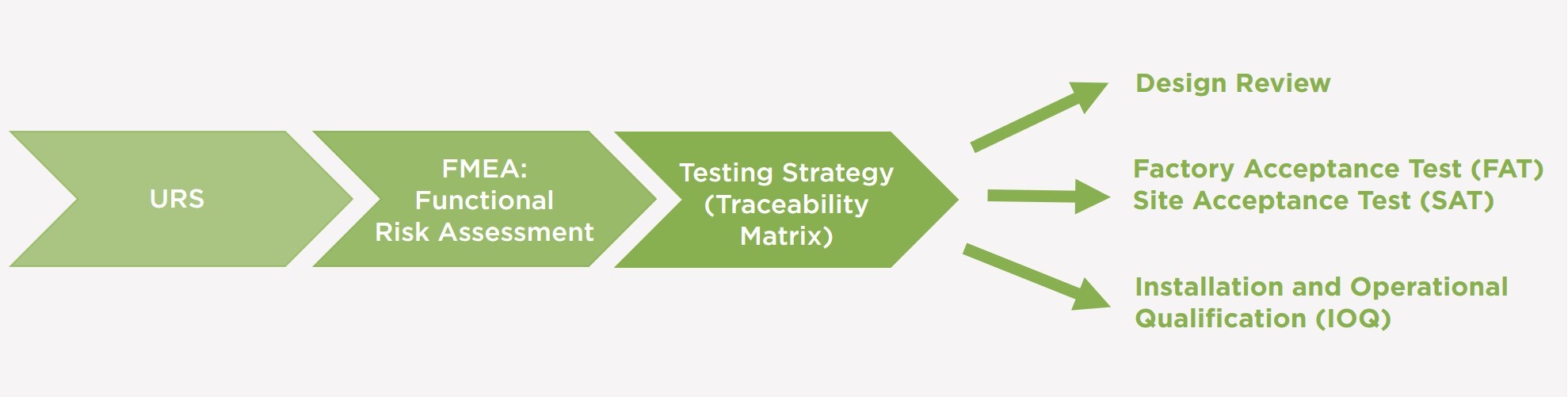
Single Use Support assists you in the whole qualification procedure to verify the employed manufacturing system is fit for its intended use and has been properly built and installed in order to ensure correct operation. All these documents can then be leveraged by the customer, providing clients with full support in risk-based approaches where the verification level and extend are based on scientifically assessed risks that specific processes, equipment or systems might pose to either the pharmaceutical product or the patient.
Additionally, to Factory and Site Acceptance Tests (FAT & SAT), Single Use Support is experienced in conducting IOQ. Installation and operational qualification covers configuration testing and functional testing with regards to customer-specific configuration., so that the system can subsequently be released for operational use in a GMP environment.
Downloads
Guide
Qualification & Validation FAQ - Guide
Please fill out the form below to download this file.
Single Use Support is pleased to announce that it has recently become a member of Rx-360, the International Pharmaceutical Supply Chain Consortium.
Sustainable Contribution to Patient and Supply Security
As a technology provider and established supplier to the pharmaceutical industry, Single Use Support’s mission is to make a sustainable contribution to global patient and supply security with our innovative and scalable solutions. By joining Rx-360, the Austrian process solution provider reinforces its commitment to security and transparency in the pharmaceutical supply chain.
As a member of Rx-360, Single Use Support will benefit from the collective knowledge and experience of the consortium, as well as the opportunity to participate in various initiatives and projects that aimed at improving the quality and safety of the pharmaceutical supply chain. Single Use Support will also be able to leverage the Rx-360 audit program, which provides a standardized and cost-effective way to assess and monitor our suppliers and service providers. It also allows Single Use Support’s customers to simplify their supplier qualification and to reduce their audit burden.
Elisabeth Haas-Karagiannidis, Director of Quality Management at Single Use Support, is pleased about the collaboration to advance common goals and objectives: “We believe that our membership in Rx-360 will not only enhance our own performance and visibility, but will also provide added value to our customers, who can be assured that our products and services meet commonly established best-practice standards of quality and integrity.”
"We believe that our membership in Rx-360 will not only enhance our own performance and visibility, but will also provide added value to our customers."Elisabeth Haas-Karagiannidis
About Rx-360
Rx-360 is a non-profit organization that brings together industry stakeholders to share best practices, educate, and collaborate to ensure the quality and integrity of the healthcare products we deliver to patients. Rx-360 provides members with access to valuable resources, such as audits, alerts, whitepapers, webinars, and working groups.
Biopharma offers a field of many potential obstacles and pitfalls. One of them is without a doubt the topic around Qualification, Validation & GMP-Compliance.Elisabeth Haas-Karagiannidis, Head of Quality Management and Validation at Single Use Support, has given some insights in the course of Single Use Support’s podcast series.
Qualification and Validation – why is it such a big issue?
Demonstrating that the equipment is suitable for its intended use by qualification & validation is a mandatory requirement for pharmaceutical industry by authorities. Depending on complexity of systems and risk for product, it can mean a lot of effort. Companies often underestimate the workload accompanied with qualification and end up exceeding project due dates.
How does such a qualification & validation process look like in theory?
It starts with defining the specific requirements of the equipment of interest. The customer needs to define for example on materials and surfaces, and for systems with software on electronic records and data integrity. Also, with regards to regulatory requirements this needs to be considered. Once the requirements are specified in detail and the functional design is agreed on, the machine can be built.Once built, it is all about testing. Testing is based on the specifications set in design phase. The extent of testing and the assignment to a testing phase is to be done by a risk-based approach, which emphasizes the focus on critical potential threats.
It is common practice that engineering companies offer a basic testing approach, the so-called FAT and SAT. But why has Single Use Support decided to offer services beyond that?
The reason is simply that we want to offer end-to-end solutions. Let me explain: FAT and SAT [factory & site acceptance test] are mainly focusing on critical technical and mechanical aspects, so what we as a manufacturer need to make sure that our product works properly. But the pharma companies need more, in order to finally release the equipment for operational use in a GMP environment. There is additional testing required to verify for example customer-specific configurations, and performance related to a customer-specific process, or tests related to 21 CFR part 11 compliance.In a nutshell, we do not want to leave our customer alone half-way, we offer the full carefree package from purchase order to release for operations and beyond.
According to your experience, what services are required from your current customers with regards to qualification/validation?
Our customers appreciate very much the services we offer beyond standard testing. We are able to adapt testing procedures to meet the customer’s needs, for example verification runs tailored to verify their specific manufacturing process, which makes qualification and validation services really fully leverageable, meaning that the customer does not need to do further testing internally. I would even name it “next-level leveraging”.
When a customer obtains technologies by Single Use Support, would it also be possible to outsource the whole qualification/validation?
Sure, no worries! It is possible to rely on our experience and let us deliver the whole package. The customer can benefit from the experience of our product experts and additionally make sure that timelines are met for sure.
[[download-1]]
Get in contact with Single Use Support!
Khalil Essani is Techical Product Owner - Sterile Consumables at Single Use Support. As single-use system enthusiast, he has led several projects to develop and deliver single-use assemblies. Working closely with various biomanufacturers he strives to provide the industry with advanced fluid management to enhance patient safety. In this interview he gives insights into the field of single-use sterilization technology.
When are single-use assemblies sterilized?
Single-use assemblies are typically sterilized at different stages depending on the specific requirements of the customer's operating environment and the need to produce a sterile product. Contamination poses a significant threat and risk to any manufacturer, impacting the effectiveness of the process and the overall safety. Therefore, the production of sterile products is always necessary and expected.
We supply single-use assemblies for various grades, including D, C, B, and A, ensuring they are manufactured in the most secure environment possible. The sterility requirements may vary throughout the process, with the highest degree of sterility necessary for the final drug product. For example, low bioburden levels are crucial to maintain sterility.
Contamination poses a significant threat and risk to any manufacturer, impacting the effectiveness of the process and the overall safety.Khalil Essani
What are typical types of sterilization for single-use assemblies?
You can distinguish between two overall types of sterilization methods used for single-use assemblies.
Irradiation methods, such as Gamma, X-ray, and E-beam (beta), are commonly employed for sterilizing single-use assemblies. These methods utilize radiation to effectively eliminate microorganisms and achieve sterilization. Both e-beam and gamma irradiation operate at the molecular level, but the difference lies in the mechanism: e-beam sterilization involves electron bombardment, while gamma irradiation utilizes cobalt or other radioactive materials.
Heat/temperature sterilization options for single-use assemblies include autoclave sterilization, which involves subjecting the assemblies to high temperatures ranging from 121-138°C under pressure, and depyrogenation, a process where the assemblies are exposed to elevated temperatures ranging from 180-400°C to remove pyrogens.
These sterilization techniques ensure the necessary level of sterility and safety for single-use assemblies, making them suitable for various applications where a sterile environment or production of sterile products is required.
What advantages does gamma irradiation have - as most used sterilization technique for single-use assemblies, compared to other sterilization methods?
When comparing irradiation methods, such as gamma irradiation, to heat sterilization, such as autoclaving, several advantages can be observed, especially in the context of single-use assemblies used in the pharmaceutical industry.
In addition to the process simplicity of irradiation methods, gamma irradiation offers distinct advantages for closed systems when using polymers, silicones, and elastomers in pharmaceutical applications. Single-use assemblies are often designed as closed systems with specific geometries that do not retain moisture. Gamma irradiation provides a straightforward sterilization process compared to the complexities of steam and heat used in autoclaving. Another advantage is the minimal surface structure alteration. Gamma irradiation has a minimal impact on the surface structure of the materials. This leads to reduced formation of extractables and leachables that can migrate from the assembly materials into the product.
Gamma irradiation is generally a versatile method that can be applied to various single-use assemblies.Khalil Essani
And why gamma as the most prominent technique within the irradiation methods? Well gamma irradiation specifically offers the following advantages over x-ray and ebeam.
First, it provides a deep material penetration: Gamma radiation with cobalt can penetrate deeper into materials compared to other methods such as e-beam sterilization with beta waves. Second, gamma irradiation is well-established and widely accepted. You don’t just change a running system without a good reason. Using gamma irradiation eliminates the need for additional validation that may be required for alternative methods like e-beam sterilization.
You can say that gamma irradiation is generally a versatile method that can be applied to various single-use assemblies. However, there may be instances where certain components, such as filters, are not compatible with gamma irradiation and require alternative sterilization methods.
What must be considered while choosing sterilization methods?
A lot of aspects and consideration should be taken into account, when choosing sterilization methods for single-use assemblies.
We start with defining customer expectations and validations. It is imperative to understand the specific requirements and expectations of the customer and ensure that the chosen sterilization method aligns with their needs. We then consider the validation requirements for the components to ensure that they remain functional after sterilization.
Also, it is important, of course, to guarantee compatibility with configurations. We verify that the assembly's configuration is compatible with the chosen sterilization method. For example, certain components like a 2-meter-long tube may not be suitable for autoclaving.
We then check the method-assembly compatibility, where we ensure that the method chosen for sterilization aligns with the design and materials used in the assembly. Each method has its limitations and specific considerations.
Finally, the logistics of sterilization must also be considered. More precisely, the logistics and practical implementation of the chosen sterilization method. We make sure that it can be effectively applied.
At Single Use Support, we take over all these services for our customers from a single source, clarify all validations and compatibilities and create a ready-to-use assembly.
Future considerations: What type of sterilization will be leading in the future?
Gamma irradiation is currently in high demand. However, it comes with longer lead times and associated costs due to supply challenges and availability. Therefore, the logistical inconvenience may drive the exploration and adoption of alternative sterilization methods.
There is potential for x-ray sterilization to become a leading sterilization method in the future. It offers potential advantages such as simplified logistics and faster turnaround times which accelerates and soothes the process. First guides to implement x-ray sterilization are already published. More and more companies validate and explore the use of x-ray sterilization, and it will be exciting to see if x-ray sterilization will replace gamma sterilization as the leading method.
IRIS Single-Use Assemblies