Efficient bulk drug substance freezing & ULT storage

Building a harmonized workflow from freezing to ultra-low temperature storage with increased cold chain capacity, reduced manual handling, and scalability within existing infrastructures.

Why Single Use Support for bulk freezing & ULT storage?

Inefficient manual workflows?

Manual handling processes of large bioprocess containers require extra operator hours, more handling steps and higher risks of handling errors & contamination.

Green icon of a downward arrow demonstrating reduced product loss

Fewer handling steps

Harmonized freezers and storage freezers simplify the handling of batches of frozen drug substances, saving operators time and reducing risks.

Growing capacity demands?

When batch volumes rise, but manufacturing facilities remain unchanged, there is need for efficient use of infrastructure.

Green icon of configuration settings on a transparent background demonstrating controlled rate freezing and thawing in biopharma

Streamlined bulk batch operations

Added freezing & storage capacity per footprint and compatible GMP-ready freezers help CDMOs cope with volatile requirements.

Handling bags & bottles?

Fragmented freezing and storage systems for single-use bags and bottles creating compliance & data integrity gaps.

Multi-format cold chain solutions

Thanks to recipe-driven freezing protocols for different bioprocess containers, the highest product quality is achieved, and cold chain operations are standardized.

Efficiency gains of a harmonized freeze-to-store workflow

  • Higher capacity per fooprint, enabling effficient use of the existing facility infrastructure.
  • Compliant and data‑ready: a continuous workflow enables consistent electronic record-keeping across freezing and storage, as per 21 CFR Part 11.
  • Reduced manual handling and operator dependency
  • Safer bulk drug substance handling with reduced contamination risk.
Manufacturing operator working with a large industrial blast freezer with a batch of drug substance.

High-capacity cold chain for bulk drug substance

Single Use Support's cold chain solutions enable efficient and scalable freeze-to-store workflows.

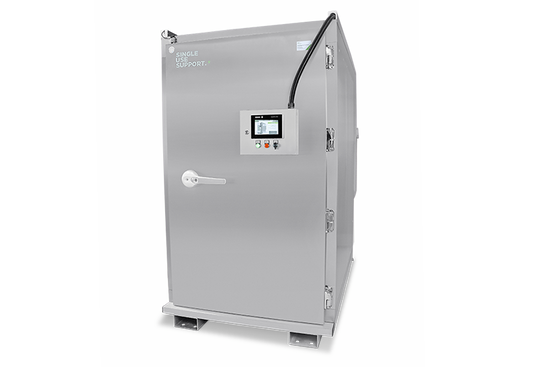
  • Controlled freezing: Our RoSS.BLST platform delivers controlled, high-capacity freezing of drug substances. It is designed to offer a best-in-class ratio of chamber volume to overall footprint.
  • Batch transfer: Frozen drug substance is transferred to storage using mobile transport racks with integrated wheels or low-profile rollers, reducing handling steps and the risk of errors and contamination.
  • Ultra-Cold Storage: The RoSS.ULTF system provides ultra‑cold storage for bulk drug substances. It enables the storage of complete frozen batches without splitting, reducing internal transport steps, and simplifying inventory management.
Person in a lab coat interacting with a large biopharma freezer

Download App Note

Freezing and Storage of Bulk Drug Substance Batches - App Note

With rising biologics volumes, and while facilities remain unchanged, freezing and storage are increasingly treated as separate unit operations. This leads to fragmented workflows with additional handling steps, increased internal transport, and elevated risk.

This app note explores how to build freezing, transfer and ultra-cold storage steps as one continuous operation, ensuring a safe, scalable cold chain process for bulk drug substance batches.

  • Interview: Why freezing and storage should not be designed independently

    As batch sizes for bulk drug substances continue to grow, many biopharmaceutical facilities are reaching the limits of their existing freezing and storage infrastructure. At first glance, this appears to be a capacity issue, but in reality, it often highlights opportunities to optimize manufacturing facility design. Freezing and ultra-cold storage are frequently treated as separate unit operations. As a result, they are planned, implemented, and optimized in isolation. At the same time, CDMOs and multi-product facilities are under increasing pressure to handle multiple primary packaging formats, ranging from single-use bags to bottles, within the same infrastructure. This adds another layer of complexity to freezing and storage operations. In practice, this separation leads to additional material handling, fragmented workflows, and avoidable operational complexity. By contrast, a more integrated approach, where freezing and storage are aligned as one continuous batch process and designed for format flexibility, can simplify operations and improve overall efficiency without increasing facility footprint. To explore this topic further, we asked Claus Exenberger, Freeze & Thaw Expert at Single Use Support, about his perspective. What are the key challenges in bulk drug substance cold chain handling today? Claus Exenberger: One of the biggest challenges is that batch volumes are increasing, while existing infrastructure remains unchanged. Expanding cold rooms or adding more freezers isn’t always feasible. "At the same time, facilities – especially those of CDMOs – need to handle different primary packaging formats depending on the product or customer. Freezing and storage systems are not always designed to accommodate this degree of operational flexibility."Claus Exenberger, Single Use Support When freezing and storage are not aligned as a single, integrated process, this leads to extra transfers, increased internal movement, and more manual handling than necessary. All of this adds to operational complexity and makes scalability more difficult. Why is it a problem when freezing and storage are not aligned as one batch process? Claus Exenberger: When freezing and storage are planned independently, you often end up splitting batches across multiple storage units. That means more handling steps, more coordination, and a higher potential for deviations. If you add multiple container formats into the mix, things become even more complex. Some systems are only partially format-flexible, so operators have to adapt workflows depending on the packaging instead of following a consistent, standardized process. It’s not just about equipment; it’s about workflow design. A lack of coordination introduces inefficiencies across the entire cold chain, and those inefficiencies usually become apparent in day-to-day operations. How do RoSS.BLST and RoSS.ULTF address these challenges? Claus Exenberger: RoSS.BLST and RoSS.ULTF are designed for different steps, but they deliver the greatest value when implemented as a combined system. RoSS.BLST supports controlled blast freezing across different container types, while RoSS.ULTF is optimized for high-density, ultra-cold storage of those same formats. That level of compatibility is important, especially compared to more limited or semi-flexible solutions. Modular interior options for a wide range of bioprocessing containers further enhance the aspects of maximizing chamber utilization and processing efficiency. Because both systems are aligned in terms of batch volume and material handling, they enable full-batch processing without disrupting the process flow, regardless of the primary packaging.  "This harmonization results in improved process control, reduced manual intervention, and the ability to increase capacity within the same facility footprint.”Claus Exenberger, Single Use Support [[download-1-email-detailed]]   What does this look like in daily operations? Claus Exenberger: In daily operations, process become significantly more streamlined and predictable. Instead of adjusting workflows for different containers or breaking batches apart, operators can work with a consistent, batch-oriented approach. The batch-wise move-in, move-out setup allows material to be frozen in RoSS.BLST and transferred directly into RoSS.ULTF using the same handling concept, regardless of whether bags or bottles are used. There’s no repacking, no redistribution, and no unnecessary back-and-forth. That reduces operator workload, simplifies logistics, and lowers overall handling risk. For CDMOs in particular, this kind of format and process flexibility is essential to handle different products without increasing operational complexity. How to optimize capacity in brownfield facilities

    READ MORE
  • Existing facilities, new demands: Optimizing cold chain biomanufacturing capacity in brownfield sites

    Biopharmaceutical manufacturing has undergone a shift toward higher production volumes, more diversified modalities, and more flexible production models. Despite these new demands for handling varying batch sizes and customer-specific requirements, expectations placed on CDMOs for new programs continue to rise. However, many of these operations still rely on brownfield facilities; sites that were not originally designed to accomodate today's level of variability in bioprocessing and hence limited biomanufacturing capacity. Expanding infrastructure is often not an option. Instead, teams are increasingly challenged to optimize existing workflows within fixed spatial and technical constraints.  So, how is it possible to increase biomanufacturing capacity without expanding their facility footprint?   What are brownfield and greenfield facilities in biopharma manufacturing? Brownfield facilities are existing production environments with fixed and already existing layouts, utilities, and equipment footprints. As processes evolve, these constraints limit flexibility and make operational adjustments more complex.  Greenfield facilities are designed from the ground up, allowing equipment, material flow, and process steps to be aligned from the beginning. This enables more efficient and scalable workflows.  Both facility types face the same pressure: increasing volumes and cost constraints make space-efficient freezing and storage essential. However, greenfield sites can plan for these equipments, while brownfield facilities must optimize within existing limitations.    Why are freezing and storage critical bottlenecks? CDMOs are dealing with increasing process complexity and variability in cold chain management due to the fact that: Single-use bioprocess container formats vary Batch sizes fluctuate Regulatory expectations continue to increase Sustainability plays a larger role There are purpose-built freezers used during drug substance production: while freezing drug substances in different bioprocess containers formats is about controlled heat transfer from ambient temperature down to -80°C (or colder), ultra-low temperature storage focuses on mid-to-long term temperature stability and consistency for cryopreservation.  Freezing and storage are closely linked but often not designed as a continuous system. This mismatch becomes particularly visible in constrained (brownfield) environments.  When freezing capacity does not align with storage capacity, materials are transferred between incompatible systems. This is why frozen batches are often split or handled together with other batches that perhaps would require other storage specifications. As a result, storage is often expanded incrementally by just adding new systems, without improving overall efficiency. And in most cases facility space is limited.  Cold chain compliance for drug substances   How can CDMOs increase biomanufacturing capacity without expanding facility space? In many cases, physical expansion is simply not feasible. Therefore, the question is more about how to increase usable capacity within the existing footprint. This shifts the focus from infrastructure to workflow design. Instead of adding more equipment, the goal is to make better use of available space by reducing inefficiencies between process steps.  One key concept that emerges in this context is full-batch handling. Rather than managing multiple partial batches across different systems, the entire drug substance batch remains in a consistent format throughout freezing and storage.  This approach reduces intervention points and allows processes to run more predictably, even in constrained environments.      How does harmonizing freezing and storage improve process efficiency? Too often, freezing and storage operations are treated in isolation despite being operationally interdependent. To be fair, there has been a lack of such compatible systems for freezing and storage available too. The result is unnecessary product handling, process interruptions, and increased operational complexity.  Harmonization improves efficiency in brownfield facilities and addresses this disconnect by aligning system capacities, chamber geometries, and operational workflows. When both steps are built around identical batch formats, processes become more predictable, transitions more seamless, and manual interventions are minimized.  Single Use Support's RoSS.BLST and RoSS.ULTF systems translate this principle into practice. While serving different purposes - controlled blast freezing and thawing on the one hand, and ultra-low temperature storage on the other, both systems feature fully compatible chamber dimensions. As a result, entire batches can be transferred directly from freezing to storage without repacking, preserving process integrity while significantly simplifying operations.  Efficiency gains extend beyond workflow optimization to facility layout and space utilization. With best-in-class usable chamber volume per footprint, RoSS.BLST enables high-capacity blast freezing within a minimal footprint - a critical advantage in space-constrained brownfield environments.    [[download-1-email-detailed]]   What does that mean for process engineers and MSAT teams?  Harmonized freezing and storage systems support a consistent, streamlined process that reduces handling, optimizes space utilization, and increases overall throughput.  Complementary systems that work together as one process help considerably to reduce the number of handling steps, aligning process capacities, and standardizing batch formats. All of these improvements can have a measurable impact on both performance and efficiency.  Equally important, these changes support compliance and documentation. When full batches are processed consistently across steps, traceability improves, and validation efforts become more straightforward.    RoSS.BLST RoSS.BLST is a controlled blast freezing & thawing system for drug substances. It is suitable for any primary packaging from all manufacturers and allows freezing and thawing down to -80°C. Its modular and mobile internal rack system offers maximal flexibility and enables a simple transfer from blast freezing to ultra-cold storage. RoSS.ULTF RoSS.ULTF is an upright ultra-low temperature storage freezer for frozen drug substances in different batch sizes. The ultra cold storage freezer maintains the desired set point temperature down to -80°C. 

    Read more
  • Evolving Methods of Bulk Freezing

    Unlocking potential with single-use bags: From outdated CryoVessels to state-of-the-art plate freezers The freezing method with multi-use cryogenic containers, also called cryovessels, has been used for decades. The open stainless-steel container is still largely in use but will be replaced bit by bit by new technologies. Why? Because the risk of contamination is much higher with cryovessels. It is barely scalable. It is not possible to control the freezing process. And the total cost of ownership is high. New technologies improve process efficiency and product quality. Examples are plate-based freezing and thawing platforms for single-use bags as primary packaging (see infographic) or controlled blast freezers for bottles. These are innovative solutions that are paving the way for the evolution of bulk drug substance freezing. What level of ROI do you think could be achieved compared to cryovessels? Evolution of bulk freezing with single-use bags How it began: CryoVessels and their scope of application The use of cryovessels in biopharmaceutical manufacturing revolutionized the freezing process of bulk drug substances. 30 to 40 years ago. The method has a long history, with advances in cryopreservation technology and vessel design contributing to improved freezing protocols. However, the use of cryovessels for freezing bulk drug substance also comes with some drawbacks. These include the need for specialized equipment, the potential for cryovessel-related challenges during scale-up, and the need for careful handling and storage conditions. Manufacturers are limited to the temperatures down to max. -50°C and must accept long freezing times of up to days until the biopharmaceutical liquids are frozen entirely in the bulky shape of the cryovessel.[[1]] Cryovessels - learn more   Switch to single-use: Blast Freezing to be established The open architecture of cryogenic steel containers has intensified the need for closed systems. Single-use technologies appeared to be the freezing method that would further reduce the risk of contamination and make the freezing process more sterile, safer and, as now proven, more sustainable.[[2]] Bulk products are now filled into single-use primary packaging in which it is frozen. This type of primary packaging includes single-use bags, bottles and other custom single-use containers. After filling into single-use bioprocess containers, they have been placed into static or blast freezing devices. Blast freezing is a commonly employed technique in the biopharmaceutical manufacturing of large volumes to achieve faster and more uniform freezing of biomaterials than with cryovessels. This method involves subjecting the samples to high-velocity cold air. However, particularly static freezers have their limitations. Since they’re originally designed to hold ultra-low temperature with air circulation, freezing in static freezers can lead to cryoconcentration, where solutes accumulate in unfrozen regions, potentially impacting product stability and quality. The same applies to uncontrolled blast freezers. Only temperature-controlled blast freezers perform precise control over the freezing process that overcome the challenges in maintaining consistent freezing conditions in different scales. For good reason controlled blast freezing is still widely applied when freezing drug substances in bulk packaging, such as bottles or bulk-packaged 2D containers. [[download-1-email-detailed]] Plate-based freezing with single-use bags: Advanced freezing for large volumes Freezing with plate-based platforms offers the advantage of direct surface contact with the single-use bag by using stainless-steel lids and their superb heat transfer properties as the only separators. While cooling energy is dispersed through air in blast and static freezers, the energy in plate-freezers transfers directly to the liquid. Direct surface contact facilitates the temperature-control inside the single-use bag and regulates the last point of freeze within the recommended scope of controlled cooling rate. The single-use bag is carried in the protective RoSS® shell. The secondary packaging around the bioprocess container enables state-of-the-art plate-based freezing with direct contact between the bag and the cooling medium. Advantages of plate-based freezing Compared to traditional and older methods of freezing biopharmaceuticals in single-use bags, plate-based bulk freezers, such as RoSS.pFTU XL, enables: Scalable freezing performance from 10mL to 50L single-use bags Control of freezing at a cooling time of less than 10 hours to -80°C of all sizes of 2D single-use bags Closed system to safeguard sterility throughout aliquoting, freezing, storing, shipping, etc. Full automation in compliance with cGMP and 21 CFR Part 11 Customized freezing rates ensuring highest product quality after cold chain management Less manual intervention, less documentation/validation, shorter process cycles Plate freezing: learn more Table 1: Comparison of drug substance freezing with cryovessels or plate-based freeze thaw platforms, when filled into 2D single-use bags and protected in the RoSS® shell.   CryoVessel Platform  Plate-Based Freeze Thaw Platform RoSS.PFTU XL  Comments Fast Freezing × ✅ The RoSS.pFTU XL achieves controlled freezing to -80°C in less than 10 hours. Low Footprint × ✅ Optimized for a maximum volume on the lowest footprint needed Vendor-agnostic primary packaging ⁓ ✅ Full freedom on choice of your primary packaging supplier to ensure a closed system.  Modularity & Scalability  × ✅ Scalable freezing with the RoSS.pFTU plate-freezers from 1L up 500L nominal volume per batch Minimum Manual Handling ⁓ ✅ Fully automated freezing process & simple loading/unloading of the palette-size racked Product Viability  × ✅ Higher product quality with controlled plate-freezing preventing the effect of cryoconcentration.  Entering new realms of freezing large volumes In step with the biotech industry, supporting process solutions are also evolving. Novel therapies require an advanced manufacturing process. The requirements for each product are constantly changing, whether in the commercial production of monoclonal antibodies (mAbs) or antibody-drug conjugates (ADCs), or preparation and processing fluids, such as buffer solutions. These sometimes complex needs can now be answered on a product-specific basis. The freeze-thaw industry has evolved from rigid processes through rigid stainless-steel vessels. Plate-based freezing with single-use bags, but also improved blast freezing with bottles allows manufacturers to adjust the freezing rate, processing volumes and endpoint temperature to meet their needs. Previously unthinkable.  Cryovessels are still in use mostly because of their history. Even though the majority of biomanufacturers still have them in day-to-day operation, the technology is outdated and not efficient. The future of freezing and thawing large volumes in single-use bags belongs to plate-based freezing in biomanufacturing. ROI of controlled bulk freezers vs. CryoVessels The benefits of controlled freezing extend beyond just process performance. When the total cost of ownership (TCO) is considered, including cleaning, validation, labor requirements, consumables, equipment replacement, and product loss risk, freezing with single-use technologies can offer a significant economic advantage over traditional cryovessel-based approaches despite their capital expenditure (CAPEX). In one manufacturing case study, Single Use Support's controlled plate freezing platform RoSS.pFTU reached the break-even point shortly after one year. Thanks to its reduced operational expenditures (OPEX), the platform generated savings of more than 2 million EUR after two years of operation. Download the case study to see the complete ROI calculation and key cost drivers.   [[download-2-email-detailed]]   Bulk freezing & storage as one end-to-end process Bulk freezing is evolving beyond faster rates and tighter process control: As batch volumes grow, manufacturers face the challenge of managing frozen drug substances efficiently across the entire cold chain. In many facilities, freezing and ultra‑cold storage are still treated as separate steps, leading to fragmented workflows, increased handling, and unnecessary transfers. A more efficient approach is to connect freezing and storage into one continuous process. By aligning capacities, entire batches can remain intact throughout freezing, storage, and downstream logistics. This reduces manual handling, simplifies batch management, and supports more consistent cold chain operations.For facilities handling larger volumes or diverse formats, integrating freeze‑to‑store workflows improves scalability without expanding footprint. Ultimately, the next step in bulk freezing is optimizing the entire batch lifecycle – not just the freezing step. More about freeze & ULT storage processes References Large-Scale Freezing of Biologics: A Practitioner’s Review, Part 2: Practical Advice, https://, Published 2009 Streamlined life cycle assessment of single use technologies in biopharmaceutical manufacture, https://pubmed.ncbi.nlm.nih.gov/35007778/, Published 2022  

    READ MORE

Talk to an expert