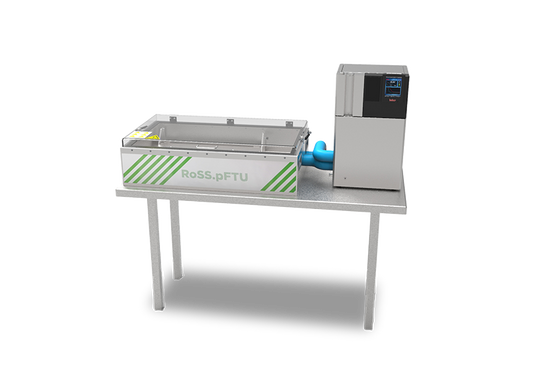
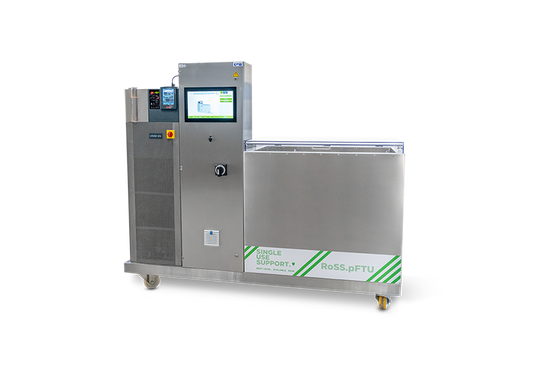
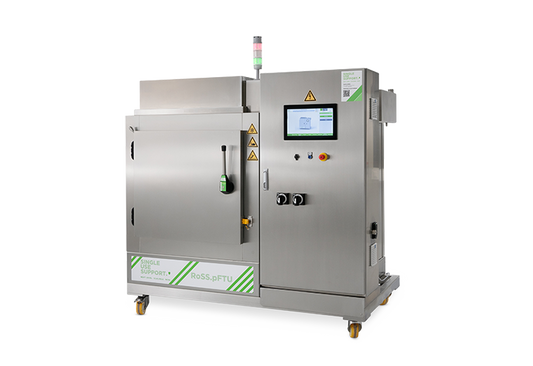
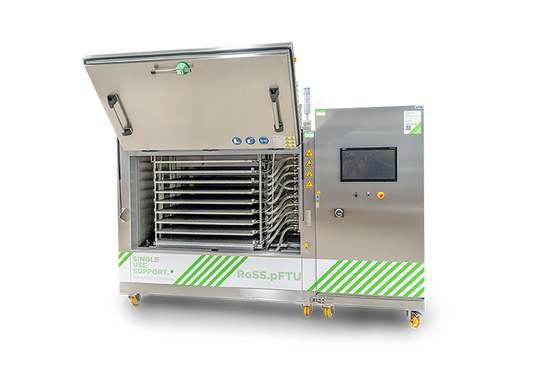


RoSS.pFTU

Scalable plate freeze-thaw platform

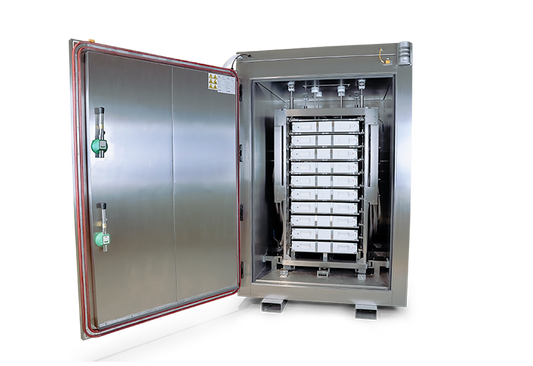
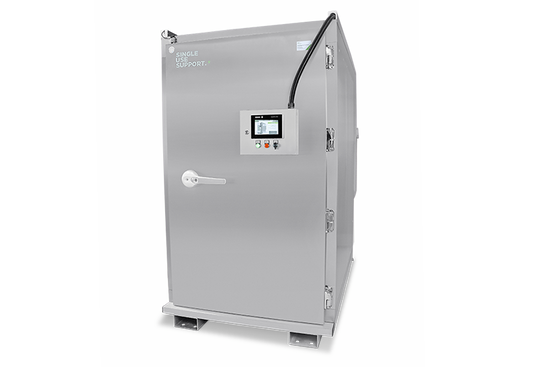
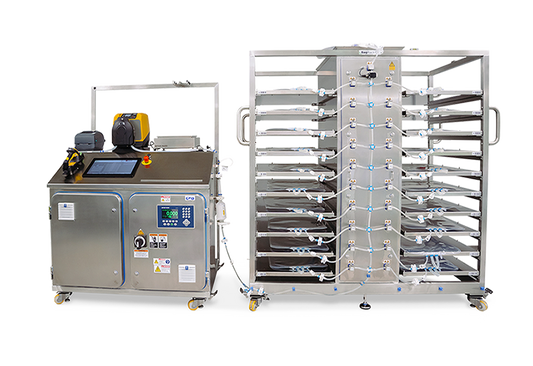
RoSS.pFTU is a plate freezer for any scale and batch size. The system is compatible with single-use bags of all sizes and manufacturers.

Image of RoSS.pFTU Large-Scale for controlled freezing and thawing of larger volumes of drug substances, on a transparent background.

Key features

Controlled freezing down to -80 °C

Enabling highest possible speed and accuracy.

Up to 500 L per batch

Suitable for single-use bags from 10 mL up to 50 L bags.

Single-use bag independent

Covering all available 2D bag vendors, types and sizes.

Best product stability results

Maintaining product integrity for mAb and other drug substances.

Automated and GMP-ready

Aligned with 21 CFR part 11.

Optimal protection

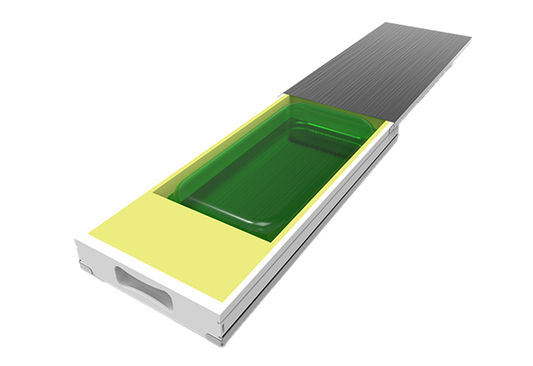
Safe handling of single-use bags during freezing in combination with RoSS® shells.

Short lead times

Standard configurations are available to support accelerated project timelines.

Graphic of different scale-up stages for freeze-thaw systems used in biopharmaceutical manufacturing.

Scale from lab to commercial production

Single Use Support platforms provide insular solutions for the freeze/thaw processes of each clinical phase. Fully scalable and compatible with all batch sizes and bags from all established manufacturers – you will only require one single system from the lab to blockbuster production. From 10 mL up to 50 L bags and a batch size of up to 500 L and more, you can scale-up or down as required.

  • Graphic of two frozen single use bags showing different freezing results with and without controlled freezing
  • To demonstrate the effects of cryoconcentration, Naphthol Blue Black was used as a visual marker. The intensity of the blue coloration indicates the concentration of dissolved substances within the frozen solution.

    Slow uncontrolled freezing (A)

    In contrast, bags frozen in a static freezer show uneven solute distribution. Dark blue areas, especially in the lower regions of the bag, highlight significant cryoconcentration.


    Fast controlled freezing (B)

    Bags frozen using our plate-based controlled rate freezer show a uniform distribution of solutes. The result is a consistent, light-blue hue with a distinct white line through the center indicating minimal cryoconcentration.

Our customers trust in us:

Downloads

Preview of datasheet for RoSS.pFTU Large Scale freeze-thaw unit by Single Use Support

Datasheet

RoSS.pFTU Large Scale - Datasheet

RoSS.pFTU Large Scale - Datasheet
 
Preview of Single Use Support's whitepaper about controlled freezing with RoSS.pFTU

Whitepaper

RoSS.pFTU - Controlled scalable freezing - Whitepaper

RoSS.pFTU - Controlled scalable freezing - Whitepaper
 
Preview of Single Use Support's 
study about scalable freezing

Whitepaper

Scalable freezing of protein-based biologics - Study

Scalable freezing of protein-based biologics - Study
 

Send a request

  • Evolving Methods of Bulk Freezing

    Unlocking potential with single-use bags: From outdated CryoVessels to state-of-the-art plate freezers The freezing method with multi-use cryogenic containers, also called cryovessels, has been used for decades. The open stainless-steel container is still largely in use but will be replaced bit by bit by new technologies. Why? Because the risk of contamination is much higher with cryovessels. It is barely scalable. It is not possible to control the freezing process. And the total cost of ownership is high. New technologies improve process efficiency and product quality. Examples are plate-based freezing and thawing platforms for single-use bags as primary packaging (see infographic) or controlled blast freezers for bottles. These are innovative solutions that are paving the way for the evolution of bulk drug substance freezing. What level of ROI do you think could be achieved compared to cryovessels? Evolution of bulk freezing with single-use bags How it began: CryoVessels and their scope of application The use of cryovessels in biopharmaceutical manufacturing revolutionized the freezing process of bulk drug substances. 30 to 40 years ago. The method has a long history, with advances in cryopreservation technology and vessel design contributing to improved freezing protocols. However, the use of cryovessels for freezing bulk drug substance also comes with some drawbacks. These include the need for specialized equipment, the potential for cryovessel-related challenges during scale-up, and the need for careful handling and storage conditions. Manufacturers are limited to the temperatures down to max. -50°C and must accept long freezing times of up to days until the biopharmaceutical liquids are frozen entirely in the bulky shape of the cryovessel.[[1]] Cryovessels - learn more   Switch to single-use: Blast Freezing to be established The open architecture of cryogenic steel containers has intensified the need for closed systems. Single-use technologies appeared to be the freezing method that would further reduce the risk of contamination and make the freezing process more sterile, safer and, as now proven, more sustainable.[[2]] Bulk products are now filled into single-use primary packaging in which it is frozen. This type of primary packaging includes single-use bags, bottles and other custom single-use containers. After filling into single-use bioprocess containers, they have been placed into static or blast freezing devices. Blast freezing is a commonly employed technique in the biopharmaceutical manufacturing of large volumes to achieve faster and more uniform freezing of biomaterials than with cryovessels. This method involves subjecting the samples to high-velocity cold air. However, particularly static freezers have their limitations. Since they’re originally designed to hold ultra-low temperature with air circulation, freezing in static freezers can lead to cryoconcentration, where solutes accumulate in unfrozen regions, potentially impacting product stability and quality. The same applies to uncontrolled blast freezers. Only temperature-controlled blast freezers perform precise control over the freezing process that overcome the challenges in maintaining consistent freezing conditions in different scales. For good reason controlled blast freezing is still widely applied when freezing drug substances in bulk packaging, such as bottles or bulk-packaged 2D containers. [[download-1-email-detailed]] Plate-based freezing with single-use bags: Advanced freezing for large volumes Freezing with plate-based platforms offers the advantage of direct surface contact with the single-use bag by using stainless-steel lids and their superb heat transfer properties as the only separators. While cooling energy is dispersed through air in blast and static freezers, the energy in plate-freezers transfers directly to the liquid. Direct surface contact facilitates the temperature-control inside the single-use bag and regulates the last point of freeze within the recommended scope of controlled cooling rate. The single-use bag is carried in the protective RoSS® shell. The secondary packaging around the bioprocess container enables state-of-the-art plate-based freezing with direct contact between the bag and the cooling medium. Advantages of plate-based freezing Compared to traditional and older methods of freezing biopharmaceuticals in single-use bags, plate-based bulk freezers, such as RoSS.pFTU XL, enables: Scalable freezing performance from 10mL to 50L single-use bags Control of freezing at a cooling time of less than 10 hours to -80°C of all sizes of 2D single-use bags Closed system to safeguard sterility throughout aliquoting, freezing, storing, shipping, etc. Full automation in compliance with cGMP and 21 CFR Part 11 Customized freezing rates ensuring highest product quality after cold chain management Less manual intervention, less documentation/validation, shorter process cycles Plate freezing: learn more Table 1: Comparison of drug substance freezing with cryovessels or plate-based freeze thaw platforms, when filled into 2D single-use bags and protected in the RoSS® shell.   CryoVessel Platform  Plate-Based Freeze Thaw Platform RoSS.PFTU XL  Comments Fast Freezing × ✅ The RoSS.pFTU XL achieves controlled freezing to -80°C in less than 10 hours. Low Footprint × ✅ Optimized for a maximum volume on the lowest footprint needed Vendor-agnostic primary packaging ⁓ ✅ Full freedom on choice of your primary packaging supplier to ensure a closed system.  Modularity & Scalability  × ✅ Scalable freezing with the RoSS.pFTU plate-freezers from 1L up 500L nominal volume per batch Minimum Manual Handling ⁓ ✅ Fully automated freezing process & simple loading/unloading of the palette-size racked Product Viability  × ✅ Higher product quality with controlled plate-freezing preventing the effect of cryoconcentration.  Entering new realms of freezing large volumes In step with the biotech industry, supporting process solutions are also evolving. Novel therapies require an advanced manufacturing process. The requirements for each product are constantly changing, whether in the commercial production of monoclonal antibodies (mAbs) or antibody-drug conjugates (ADCs), or preparation and processing fluids, such as buffer solutions. These sometimes complex needs can now be answered on a product-specific basis. The freeze-thaw industry has evolved from rigid processes through rigid stainless-steel vessels. Plate-based freezing with single-use bags, but also improved blast freezing with bottles allows manufacturers to adjust the freezing rate, processing volumes and endpoint temperature to meet their needs. Previously unthinkable.  Cryovessels are still in use mostly because of their history. Even though the majority of biomanufacturers still have them in day-to-day operation, the technology is outdated and not efficient. The future of freezing and thawing large volumes in single-use bags belongs to plate-based freezing in biomanufacturing. ROI of controlled bulk freezers vs. CryoVessels The benefits of controlled freezing extend beyond just process performance. When the total cost of ownership (TCO) is considered, including cleaning, validation, labor requirements, consumables, equipment replacement, and product loss risk, freezing with single-use technologies can offer a significant economic advantage over traditional cryovessel-based approaches despite their capital expenditure (CAPEX). In one manufacturing case study, Single Use Support's controlled plate freezing platform RoSS.pFTU reached the break-even point shortly after one year. Thanks to its reduced operational expenditures (OPEX), the platform generated savings of more than 2 million EUR after two years of operation. Download the case study to see the complete ROI calculation and key cost drivers.   [[download-2-email-detailed]]   Bulk freezing & storage as one end-to-end process Bulk freezing is evolving beyond faster rates and tighter process control: As batch volumes grow, manufacturers face the challenge of managing frozen drug substances efficiently across the entire cold chain. In many facilities, freezing and ultra‑cold storage are still treated as separate steps, leading to fragmented workflows, increased handling, and unnecessary transfers. A more efficient approach is to connect freezing and storage into one continuous process. By aligning capacities, entire batches can remain intact throughout freezing, storage, and downstream logistics. This reduces manual handling, simplifies batch management, and supports more consistent cold chain operations.For facilities handling larger volumes or diverse formats, integrating freeze‑to‑store workflows improves scalability without expanding footprint. Ultimately, the next step in bulk freezing is optimizing the entire batch lifecycle – not just the freezing step. More about freeze & ULT storage processes References Large-Scale Freezing of Biologics: A Practitioner’s Review, Part 2: Practical Advice, https://, Published 2009 Streamlined life cycle assessment of single use technologies in biopharmaceutical manufacture, https://pubmed.ncbi.nlm.nih.gov/35007778/, Published 2022  

    READ MORE
  • Sustainable freezing in biopharma: Emerging trends & the role of natural gas

    There will continue to be an ongoing need for cryopreservation and cold chain management of drug substances. However, these processes will no longer depend on F-Gases.  The utilization of F-gases, also known as fluorinated greenhouse gases, is steadily declining in the biopharmaceutical sector and is expected to be banned in the near future. Regulatory frameworks, such as EU Regulation 573/2024, are setting the standards as they support the overarching goal of curbing emissions linked to F-gases used for freezing drug substances in single-use containers. To enable more environmentally friendly freezing of drug substances, the industry must develop and implement more sustainable technologies. One notable trend is the growing adoption of natural gases for refrigeration. This transition is already evident at Single Use Support, where all freezing platforms and ultra-low temperature storage platforms are now available with natural gas technology. But is sustainable freezing truly possible? What challenges accompany the shift to natural gas-powered refrigeration platforms in pharmaceutical manufacturing? And which emerging trends further advance the principles of green engineering (even more) to go toward Global Warming Potential of zero?  Alexander Fuchs, Director Product Innovation at Single Use Support, sheds light on these aspects. What natural gases are used and what role do they play in Biopharma freezers? Alexander Fuchs: We equip our plate-based freezers, blast freezers and ULT storage freezers with natural gas refrigeration technology. R170 ethane, R1150 ethylene, R290 propane and R1270 propylene are natural gases that are not exclusively used by Single Use Support but increasingly adopted by other solution providers as well. The EU regulation 573/2024 mandates a gradual 70% reduction in F-gas emissions by 2030 to mitigate global warming potential (GWP). This directive has prompted manufacturers and solution providers to transition to sustainable alternatives. Non-compliance with the F-gas Regulation beyond 2030 entails penalties, underscoring the urgency of meeting sustainability targets. Even though solutions with F-gas cannot be placed on the market after 2030, they can still be used with the requirement of shortened maintenance intervals the greater the amount of F-gas used. While freezing equipment performing below -50° C is exempt from these regulations until 2030, Single Use Support and its customers already now embrace the trend toward eco-friendly solutions. Even as we offer solutions like the RoSS.pFTU plate freezer for controlled freezing of single-use bags, the RoSS.BLST blast freezer for controlled freezing of bulk packaging including bottles to -80° C, and the RoSS.ULTF for ultra-cold storage down to -80° C, all powered by natural gases. What are the big advantages of using natural gases? Alexander Fuchs: First and foremost, natural gases are not scarce and more readily available than fossil fuels. The incorporation of natural gases into a manufacturing suite does not require a complete overhaul, as these processes can be smoothly assimilated into the biopharmaceutical cold chain storage. Moreover, natural gases are more efficient than F-gases. This energy efficiency translates into a significantly reduced charge requirement, about 1/6th of what was previously needed with F-gases for our RoSS.ULTF, while achieving equivalent performance outcomes.   So why hasn't natural gas always been the obvious choice? Alexander Fuchs: Natural gas is more flammable. The combustibility of natural gas poses a safety concern in biomanufacturing environments. Exceeding a threshold of 500 g per platform triggers a cascade of measures, including infrastructure upgrades. As long as the natural gas charge remains below 500 g per platform, safety protocols are unaffected. This is why we design our RoSS.BLST and RoSS.ULTF to stay below this threshold and as technically permanently sealed systems in accordance with EN378 and ISO 60335-2-89. Importantly, the freezing performance remains uncompromised. So, switching to R170 (ethane) or R290 (propane), for example, does not impact cooling efficiency or reliability. Once safety requirements are met, users experience no noticeable difference. How do natural gases pave the way to Green Engineering and sustainable biopharma practices? Alexander Fuchs: Driven by the F-gases regulation, manufacturers and solution providers are compelled to pursue sustainability. Having such initiatives and guidelines in place is essential to collaboratively reduce emissions and lower GWP. The growing emphasis on natural gas usage supports Green Engineering by integrating life cycle thinking into all engineering processes. This entails minimizing resource depletion, reducing waste generation, and optimizing energy inputs and outputs for maximum safety and eco-friendliness. "The use of natural gases is, after all, a step towards a more sustainable biomanufacturing environment." Alexander Fuchs | Single Use Support However, it's imperative to view this as just one step toward a fully sustainable biomanufacturing landscape. It lays the foundation for future engineering innovations and solutions aimed at refining current technologies and achieving holistic sustainability. For example, CO2 could be a very promising refrigerant for the future - even though it cannot be used for ultra-cold conditions to -80° C. As an environmentally compatible temperature control solution carbon dioxide does not have ozone depletion potential and offers a very low GWP. Are natural gases the end of the line for sustainable freezing? Switching to natural gas and natural refrigerants marks an important step toward sustainable freezing, as it significantly reduces emissions and Global Warming Potential. However, further alternatives stemming from the great commitment of life science solution providers to ongoing development will soon enter the market. One promising approach is the use of pressurized air as a refrigerant. We are currently testing and evaluating temperature control units designed to achieve a Global Warming Potential of zero. These units will be integrated into our freezing devices, representing another major step toward making the freezing of drug substances even more sustainable. "Starting in 2026, customers will be able to access advanced cooling technologies with a GWP of zero in Single Use Support’s freezers."Alexander Fuchs | Single Use Support Overall, there is still room for improvement. The entire industry must commit to a green path; one that goes beyond natural gas. Like other innovators, Single Use Support will continue collaborating with customers to develop eco-friendly solutions. After all, innovation will shape the future of sustainability. Key takeaways Natural refrigerants are replacing F-gases in biopharma freezing due to regulatory pressure such as EU Regulation 573/2024 mandating a 70% reduction in F-gas emissions by 2030. Natural gases in biopharma freezers, including R170, R1150, R290 and R1270, deliver reliable, low-temperature performance while significantly reducing global warming potential (GWP) Freezers operating with natural refrigerants support the principle of green engineering by enabling more energy-efficient cooling cycles, reduced emissions and more environmentally responsible cold chain infrastructures. Airflow-based cooling technology offer an additional option to achieve a GWP of zero in biopharma freezing applications Explore Single Use Support's sustainable freezers

    Read more
  • Safe handling of bulk drug substances

    While one of the main goals of bulk drug substance management is to ensure quality control, safety during manufacturing, storage and transportation are of great importance. Nevertheless, the safe handling of bulk drug substances is a necessary measurement when dealing with sensitive and potentially hazardous drug substances. Bulk drug substance management - read more Reducing risks when dealing with toxic drugs There are different risks associated with the handling of hazardous drugs that have to be taken into account. On the one hand, the quality of the product has to be guaranteed to protect patients from unwanted consequences. Furthermore, loss of drug substance has to be avoided, since this can be bound to considerable costs as well as delays in deliveries. On the other hand, the staff’s safety has to be secured when handling drug substances. This is especially true considering toxic substances like Antibody-Drug Conjugates: Manufacturers need to avoid staff from being exposed to ADCs and other hazardous drugs, as this may be related to severe health consequences for employees. To ensure that these risks are minimized, the Food and Drug Administration has to approve substances for safe use. However, compound drugs are often not FDA approved due to a lack of review and evaluation on their safety and effectiveness. The drug quality and security act was added as an amendment to the federal food drug and cosmetic act that allowed for more authority on the regulation and monitoring of compounded drugs by the Food and Drug Administration.[[1]] Critical steps in the production of bulk drug substances There are several critical steps in the production of bulk drug substances that can lead to a risk in patient safety through contamination and product loss. Through the optimization of filling, freezing and thawing methods as well as storage and transport conditions, the supply of highest product quality can be guaranteed. Safe storage and transport of bulk drug substances Considering their considerable value and often great diligence, bulk drug substance has to be protected during storing and shipping to prevent spoilage and product loss. Single-use bags, protected by robust and safe secondary packaging,  do not take up much space and can be stored most efficiently. Further, smart secondary packagings allow for rapid and controlled freezing. Therefore, Single Use Support developed a protection system for single-use bags that absorbs external mechanical influences and reduces the tension on the single-use bag.[[2]] Protected filling and freezing Filling of substances into bio containers bears its complications and product loss through handling failures can occur. Nevertheless, the most frequent filling errors are related to equipment failure, human error or consumable failure. To prevent product loss through manual intervention, Single Use Support has developed a fully automated filling and filtration systems for single-use bags. Additionally, they reduce the risk of exposure, since the process is performed within an enclosed system.   Controlled freezing of drug substance helps to maintain product quality and to guarantee safe storage. As insufficient freezing can stress the protein and lead to damage of the product, Single Use Support uses freezing platform systems that prevent unwanted alterations in the product through plate freezing. Filling of drug substance – read more Minimizing risks during thawing and draining As the process of thawing and draining drug substance is as sensitive as the process of freezing, Single Use Support has developed a fully automated freeze/thaw platform that can be used for any batch size. The devices are able to carry out both the freezing and thawing process, delivering high product stability via controlled freeze-thaw rates. Nevertheless, even small process deviations can have big consequences in the handling of bulk drug substances. For staff members, this means to be on alert during every step of cold chain logistics, monitor the different steps and protect themselves from safety risks caused by exposure. For patients, on the other hand, product loss can result in supply chain delays. [[download-1]] [[download-2]] End-to-end solutions for the safe handling of bulk drug substances – with Single Use Support Single Use Support has developed an entire product line-up suitable for the safe and adequate handling of bulk drug substances, based on single-use technologies. With automated filling systems, loss of drug substances can be reduced significantly. This reduces the risk of contamination related to the exposure to potentially toxic substances. And with solutions for controlled freeze/thaw processes as well as dedicated draining methods, spoilage and unwanted alterations of biopharmaceutical products can be prevented. Single Use Support’s solutions are fully customizable and adaptable to small-scale and large-scale requirements. Due to their flexibility and effectiveness, Single Use Support’s end-to-end solutions are the ideal choice for various processes within bulk drug substance management. End-to-end solutions in drug substance management References Safety Risks Associated with Certain Bulk Drug Substances Nominated for Use in Compounding, https://www.fda.gov/drugs/human-drug-compounding/safety-risks-associated-certain-bulk-drug-substances-nominated-use-compounding, Published 2022 Time- and Temperature-Controlled Transport: Supply Chain Challenges and Solutions, Time- and Temperature-Controlled Transport: Supply Chain Challenges and Solutions - PMC, Published 2018

    READ MORE

FAQ about plate freeze-thaw units

What are the economic benefits of controlled plate freezing for bulk drug substance manufacturing?

+

The economic impact of bulk drug substance freezing extends beyond the initial equipment investment (CAPEX). Labor, cleaning, validation, consumables, equipment replacement, and quality-related product loss can all contribute significantly to long-term manufacturing costs. Controlled plate freezing helps reduce these operational burdens while supporting consistent freezing performance in single-use bags.

In one manufacturing case study, a controlled plate freezing platform generated more than 2 mio EUR in cumulative savings after two years of operation. By lowering operational expenditures (OPEX) while helping preserve product quality and reducing contamination risk, controlled freezing can deliver measurable value throughout the product lifecycle.