Why are so many biopharma manufacturers adopting single-use technology instead of traditional stainless-steel systems?
The answer goes far beyond convenience. Single-use technology has become one of the most transformative developments in modern biopharmaceutical manufacturing, helping companies improve flexibility, reduce contamination risks during the handling of bulk drug substance, and improve overall cost-effectiveness across their operations. As biologics, cell and gene therapies, and other advanced therapeutics drive demand for more agile manufacturing approaches, single-use technology has evolved from a niche solution into an established industry standard.
But how did this transformation happen, and what benefits continue to drive its widespread adoption across bioprocessing and biopharmaceutical production?
Overview of biopharma processes
[[ToC]]
Trend towards Single-Use Technologies
It is a well known fact that this industry is changing incrementally due to strict regulatory regulations. While some single-use components, such as tubing and filter cartridges, have been in use for quite some time and their markets approaching saturation, several products were just recently introduced on commercial scale, e.g. disposable chromatography devices, media bags and tangential flow filtration devices. Their markets even showed double-digit growth rates in 2017.[[1]]


Are single-use technologies more sustainable than stainless-steel equipment?
Aligned with ESG goals for clean water and sanitation, single-use technologies conserve resources used for biomanufacturing[[2]]:
- 87% less water, mainly achieved due to the reduced requirement for cleaning
- 95% fewer chemicals, equally due to reduced cleaning and sterilization
- 30% less electricity, which stems from the smaller footprint of facilities and equipment
Those are astonishing and especially promising numbers and would help improve the biopharma industry, not only in making production smarter and cheaper, but also by keeping supply chains intact.
Adding to that, this shows, today, single-use systems challenge the procedure of re-using stainless-steel equipment, which was an established technique in biopharmaceutical manufacturing, that entails complex cleaning processes to avoid risks such as cross-contamination or the failure to achieve sterility.
Single-use systems in Biopharma - an overview from the beginning
Single-use technologies have been in use since the early 1990s. Due to the need to move ever-increasing volumes of serum, biotech labs initially started using plastic bags common in the food industry.
Once the serum arrived at the manufacturers’ labs packaged in plastic bags, it didn’t take long for them to start imitating and adopting this type of container for their high-quality drug substance. Consequently, this brought with it the need for specific technologies geared towards single-use consumables that were both flexible and scalable.
While avoidance of tedious and costly cleaning and maintenance processes were the initial drivers for the development of single-use technologies, they are now not only seen as more cost-effective, but also as a safer alternative to traditional technologies. Since then, major milestones have been achieved.
In the early 2000s, aseptic disposable sampling systems have been introduced. Another milestone was the introduction of single-use bioreactors. Manufacturing facilities realized the immense advantages of single-use technology for the pharma industry, e.g. in gene therapy. Since then, many single-use facilities have been opened and counting. For example, in 2017 already 66% of pharmaceutical companies preferred single-use bioreactors over the traditional stainless-steel bioreactors.
And the figures from the previous paragraph on the trend toward single-use technology show that the development is still continuing. But why exactly are so many manufacturers switching to single-use systems?
What are the main advantages of using single-use technologies?
Single-use technologies offer a combination of flexibility, scalability, and contamination control that has significantly transformed modern biopharmaceutical manufacturing. Preassembled, pre‑sterilized containers and fluid pathways enable closed and aseptic processing, reducing the risk of cross-contamination while minimizing the need for cleaning and sterilization between batches. This not only accelerates production workflows and shortens changeover times, but also supports cGMP-compliant manufacturing from process development through commercial production.
A key advantage of single-use technology is its ability to provide a streamlined, scalable process across different manufacturing stages. The same platform can often be used from early process development and pilot-scale operations through to large-scale commercial manufacturing, facilitating process transfer and reducing scale-up challenges. As production volumes continue to increase, manufacturers require technologies that can efficiently bridge the gap between small development batches and high-volume commercial production without compromising process consistency or product quality. Single-use platforms, particularly when implemented as closed systems, support reproducibility and contamination control across scales, thereby improving overall process robustness.
These benefits have driven the widespread adoption of single-use systems across a broad range of applications, including monoclonal antibodies, vaccines, viral vectors, mRNA-based therapeutics, and cell and gene therapies. In particular, emerging modalities often require flexible manufacturing setups, smaller batch sizes, rapid product changeovers, and strict contamination control under GMP conditions – all areas where single-use technologies excel. In addition, modern single-use platforms can integrate components such as filters, single-use sensors, and sampling systems as needed, creating modular and adaptable process solutions tailored to specific manufacturing requirements. These systems can be configured as closed, automated workflows, minimizing human intervention and further reducing contamination risk while enhancing process efficiency.
Single-use bioprocessing - read more
Cost efficiencies with single-use technologies
As a result of the application of single-use technologies (SUT), the manufacturers can rely on financial assets. With the switch to single-use tubing assemblies, costs are reduced in many ways.
- Cost reduction through time savings
- Cost reduction through energy savings
- Cost reduction through water savings
- More favorable CO2 footprint
- Less instrumentation/utility demand required
- Lower risk of contamination
- Lower investment costs
- more capacities can be purchased with limited start-up budget
- investment sum to be amortized is lower
- overall, variable costs are lower
The reduction in costs is just one of the numerous advantages of using SUT in biopharmaceutical manufacturing. The simplified application also promises advantages for the user. Find all the benefits of single-use systems in the specific fields of application in the following paragraphs. (Source: NNE, Beroe)
Flexibility and scalability of single-use platforms
While conventional stainless-steel systems have been established as the basis of safe and reliable manufacturing processes for both classical pharmaceuticals and advanced biologics over decades, they are not exactly flexible. However, the complex processes involved in the production of biopharmaceutical compounds require great flexibility, while they should at the same time be cost-efficient.
This is where disposable single-use components come into play: Not only do they reduce the risk of cross contamination, they are also less expensive, easier to use and provide more process flexibility than traditional processing technologies.
The advantages that set them apart from the traditional and rather unwieldy stainless-steel systems and cryovessels speak for themselves, even at a glance:
Increased flexibility:
Tubing and filters are made of flexible materials such as plastic or silicone and can be modified easily and quickly, as opposed to rigid stainless-steel pipes.
Reduced cleaning requirements:
While steel components need to be cleaned after every batch, single-use equipment comes pre-sterilized and ready to use, leading to
-
- increased turnaround times and
- reduced risk of cross-contamination
Decreased footprint and costs:
Single-use technology requires less equipment to be stored on-site, plus the omission of cleaning and maintenance further reduces costs and storage requirements.
What are the limitations of single-use technology?
While single-use technologies still have their limitations, ongoing research and development are providing new and improved solutions at an accelerated rate. Until recently, single-use bags were the main source of constraint, as they could only handle small to medium-sized volumes of highly valuable drug substance.
However, advances in bioprocessing technology, notably a steadily increasing upstream productivity, are consistently pushing the limits. Single-use platforms can now accommodate up to 2,000 L; especially when having multiple systems running in parallel, they can compete with stainless steel vats and systems when it comes to producing enough to supply commercial markets.
So even though to date nearly all commercial manufacturing of biopharmaceuticals has involved the use of unwieldy stainless steel-based tanks and facilities, this is starting to change. And it is expected to transform the industry even more in the near future, with some new facilities implementing multiple 1,000 to 2,000 L bioreactor-based single-use systems in parallel in order to manufacture volumes comparable to traditional stainless-steel production lines.
Another reason for increased adoption of SUT can be found in the growing trend and need for personalized therapies such as cell therapies and ATMP (short for Advanced therapy medicinal products). The small volumes required for such treatments are not processed in massive tanks and so are single-use technologies the perfect solution to cope with both of adaptability and scalability of manufacturing.
Challenges and solutions for single-use technologies
In an annual survey of biopharmaceutical manufacturing professionals conducted by BioPlan Associates, the potential “breakage of bags and loss of production material” was still cited as a major disadvantage of single use systems by 46.2% of respondents.[[1]]
It remains one of the main weak points of single-use, but there is a solution:
The very nature of single-use bags for biopharmaceutical purposes, which are generally made of a high-quality, yet thin and sensitive plastic membrane, makes them prone to breakage and leakages caused by external stress and impact. This can lead to contamination and loss of highly valuable drug substance.
In order to eliminate this risk, Single Use Support has developed the so-called RoSS® shell that offers a protective sleeve for filled and frozen single-use bags protection of any size. It is made up of a layer of soft 3D foam and a protective sleeve of robust and compact stainless steel to keep the content safe from external impact.
Solutions based on single-use systems
Single Use Support's end-to-end solutions are based on single-use consumables and platform systems for controlled freezing and thawing, ultra cold storage and automated filling and draining.
Automated bulk filling systems for monitored single-use processes
The latter, namely a decreased footprint of biomanufacturing at better costs, is one of the key advantages to be considered when contemplating a change to single-use systems: With their relative compact size automated filling systems for single-use bags, both for bulk and lab purposes, are a space- but also cost-saving and time-efficient solution to handle the entire pharmaceutical logistics process, including filtration, filling as well as freezing and thawing – simply put, they are the way forward.
Single-use bioprocess containers, which are the initial cause for the emergence of and the basis for all single-use technologies, also score on several levels: When empty, single-use bags are compact and require very little storage space.

In addition, they are widely available in a range of sizes and capacities to cover different needs. Single-use technologies are generally compatible with bioprocess containers of any brand and size, without the need for complicated and tedious adaptations or adjustments.
Unlike stainless-steel systems that incorporate fixed components such as connectors, filters and pipes, single-use systems make use of pre-sterilized disposable parts that require no cleaning.
Flexible single-use filtration systems
In environments and industries where sterility is the norm, filtration becomes an important part in the handling of drug substances. A number of applications performed in clean rooms, such as the recovery of antibodies or the reduction of bioburden after cell harvest, require large filtration areas.
And as different substances have different requirements, not every filter may be suitable for every substance – adding yet another challenge calling for a flexible solution. Due to increasing batch volumes from pilot to manufacturing scale, production processes become increasingly complex. This can require filter areas varying in size and covering more than 100 square feet, as well as the incorporation of one or numerous filter capsules and connectors.
Especially after the implementation of GMP Annex 1, emphasizing on PUPSIT, handling and efficiency with the ideal filtration solution is essential. Filters can be integrated into Single Use Support's filling machines. coming not only in a choice of sizes but also for different pore sizes. This ready-to-use application not only minimizes time and effort but – above all – the risk of contamination.
Advanced cold chain handling and storage with SUT

Single-use bioprocess containers have also proven to be the ideal approach for the entire cold-chain process, including storage. They are a versatile and multilateral solution for a flexible – and above all scalable – freeze-thaw process, plus they add to the quality of the frozen goods.
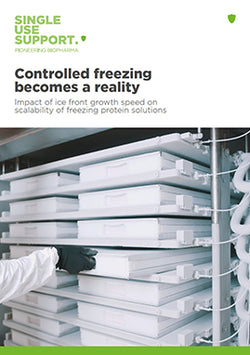
Plate freezing allows for a speedy and at the same time controlled freezing of the valuable liquid solution contained in the single-use bag: Direct contact between freezing plates and the 2D bag leads to a more consistent freezing of the single-use bag’s content at a higher speed. Slow freezing rates of traditional freezers, on the other hand, lead to the formation of large crystals that can cause friction and will increase cryoconcentration which impacts the quality of the drug substance.
However, due to their sensitive nature, single-use bags require some sort of protection, not least during shipping. Within the freezing process temperatures between -20 °C and -80 °C can occur. This can cause assembly components with inadequate protection to break and single-use bioprocess containers to rupture, which will invariably cause an excessive waste of valuable drug substance.
Single Use Support has developed the RoSS® shell, a secondary packaging to protect single-use bags during the cold chain process, the stainless steel not only acting as a protective shield but also offering the best possible heat transfer from freezer to bag to liquid.
On the inside, the bag is further embedded in a layer of soft 3D foam which hardens at approx. -20°C which fully immobilizes the single-use bag. The shell is tamper-proof, so the bag contained within cannot be accessed during the entire controlled freezing and logistics process.
Single-use technology - independent choice of the supplier
Traditional manufacturing systems often create dependencies on a single supplier, making process changes complex and costly. In contrast, modular single-use technologies provide greater flexibility by combining components such as bioprocess containers, tubing assemblies, filters, and sensors to meet evolving process needs.
This adaptability supports applications ranging from process development to commercial manufacturing and has accelerated the adoption of single-use systems for monoclonal antibodies, vaccines, viral vectors, mRNA therapeutics, and cell and gene therapies. Ultimately, single-use technology helps manufacturers remain agile, optimize processes, and reduce long-term operational dependencies.
Single Use Support helps biopharmaceutical manufacturers implement scalable, vendor-independent fluid management and cold chain solutions based on single-use technologies that support process flexibility, contamination control, and efficient technology transfer from development to commercial production.
References
- American pharmaceutical review™, https://www.americanpharmaceuticalreview.com/Featured-Articles/354820-Biopharmaceutical-Manufacturing-is-Shifting-to-Single-Use-Systems-Are-the-Dinosaurs-the-Large-Stainless-Steel-Facilities-Becoming-Extinct/, Published 23.10.2018
- BPSA: Single-Use Technologies improve healthcare outcomes and reduce environmental impacts. Infographic. 2025: Product: BPSA SUTs Sustainability Infographic: BPSA