

RoSS.pFTU XL

Bulk Drug Freezer

Plate-based freezing & thawing of up to 500L per batch.

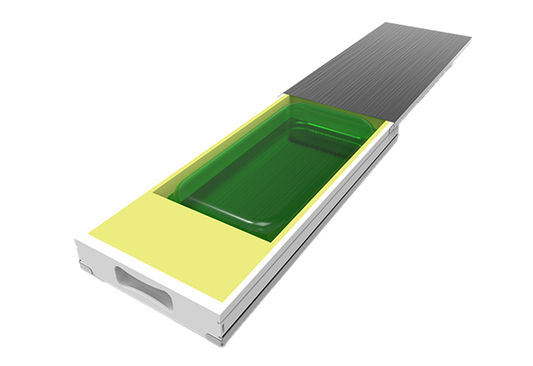
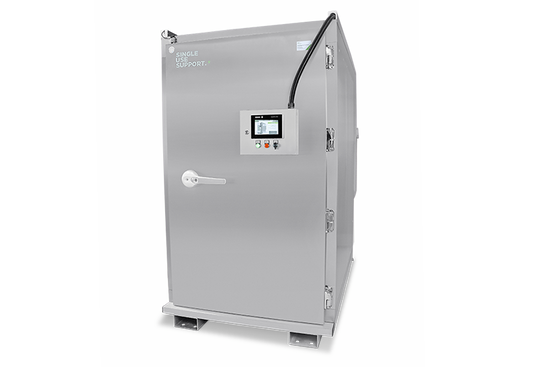
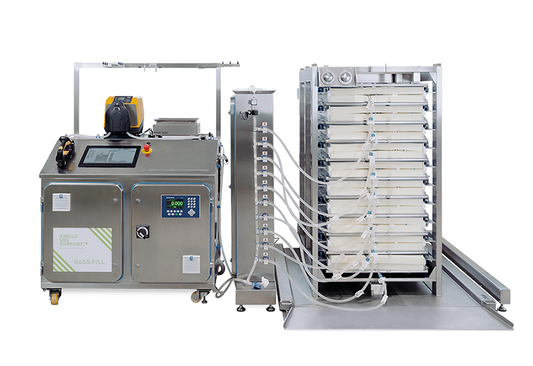
Image of bulk drug substance freezer RoSS.pFTU XL, on transparent background.

Key Features

Controlled freezing down to -80 °C

Enabling highest possible speed and accuracy.

Up to 500 L per batch

Capacity of up to 500 L nominal volume per batch (10x50L bags)

Shaker Function

Thawing with integrated shaker function.

Single-use bag independent

Covering all available 2D bag vendors, types and sizes.

Best product stability results

Maintaining product integrity for mAb and other drug substances.

Automated and GMP-ready

Aligned with 21 CFR part 11.

Optimal protection

Safe handling of single-use bags during freezing in combination with RoSS® shells.

Short lead times

Safe handling of single-use bags during freezing in combination with RoSS® shells.

When is RoSS.pFTU XL the right solution?

RoSS.pFTU XL is an automated plate-based freeze-thaw unit for 500 liters per batch of liquid substances including vaccines, media, buffer solutions or other drug substances.

The platform can freeze large volumes in 50L single-use bags, if manufacturers or CDMOs require fast batch freezing and transport, for example during fermentation in upstream bioprocessing.

Advantages of RoSS.pFTU over other solutions in the industry

Cryovessel platform 1

Blast-Freezer platform 2

Plate-based freeze-thay platform RoSS.PFTU XL

Comments

Fast-Freezing

×

×

The RoSS.PFTU XL achieves controlled freezing to -80°C in less than 10 hours

Vendor-agnostic primary packaging

×

Full freedom of choice of your primary packaging supplier to ensure a closed system

Modularity & scalability

×

×

Scalable freezing with RoSS.pFTU plate-freezers from 1L up to 500L nominal volume per batch

Minimum manual handling

Fully automated freezing process & simple loading/unloading with a specific external rack

Product viability

×

×

Higher product quality with controlled plate-freezing preventing the effect of cryoconcentration

Our customers trust in us:

Downloads

Preview of datasheet for RoSS.pFTU XL freeze-thaw unit by Single Use Support

Datasheet

RoSS.pFTU XL - Datasheet

RoSS.pFTU XL - Datasheet
 
Preview of Single Use Support's case study about the ROI of bulk freezing

Case Study

The ROI of Bulk Freezing with Plate Freezers - Case Study

The ROI of Bulk Freezing with Plate Freezers - Case Study
 
Preview of Single Use Support's whitepaper about controlled freezing with RoSS.pFTU

Whitepaper

RoSS.pFTU - Controlled scalable freezing - Whitepaper

RoSS.pFTU - Controlled scalable freezing - Whitepaper
 

Send a request

  • Evolving Methods of Bulk Freezing

    Unlocking potential with single-use bags: From outdated CryoVessels to state-of-the-art plate freezers The freezing method with multi-use cryogenic containers, also called cryovessels, has been used for decades. The open stainless-steel container is still largely in use but will be replaced bit by bit by new technologies. Why? Because the risk of contamination is much higher with cryovessels. It is barely scalable. It is not possible to control the freezing process. And the total cost of ownership is high. New technologies improve process efficiency and product quality. Examples are plate-based freezing and thawing platforms for single-use bags as primary packaging (see infographic) or controlled blast freezers for bottles. These are innovative solutions that are paving the way for the evolution of bulk drug substance freezing. What level of ROI do you think could be achieved compared to cryovessels? Evolution of bulk freezing with single-use bags How it began: CryoVessels and their scope of application The use of cryovessels in biopharmaceutical manufacturing revolutionized the freezing process of bulk drug substances. 30 to 40 years ago. The method has a long history, with advances in cryopreservation technology and vessel design contributing to improved freezing protocols. However, the use of cryovessels for freezing bulk drug substance also comes with some drawbacks. These include the need for specialized equipment, the potential for cryovessel-related challenges during scale-up, and the need for careful handling and storage conditions. Manufacturers are limited to the temperatures down to max. -50°C and must accept long freezing times of up to days until the biopharmaceutical liquids are frozen entirely in the bulky shape of the cryovessel.[[1]] Cryovessels - learn more   Switch to single-use: Blast Freezing to be established The open architecture of cryogenic steel containers has intensified the need for closed systems. Single-use technologies appeared to be the freezing method that would further reduce the risk of contamination and make the freezing process more sterile, safer and, as now proven, more sustainable.[[2]] Bulk products are now filled into single-use primary packaging in which it is frozen. This type of primary packaging includes single-use bags, bottles and other custom single-use containers. After filling into single-use bioprocess containers, they have been placed into static or blast freezing devices. Blast freezing is a commonly employed technique in the biopharmaceutical manufacturing of large volumes to achieve faster and more uniform freezing of biomaterials than with cryovessels. This method involves subjecting the samples to high-velocity cold air. However, particularly static freezers have their limitations. Since they’re originally designed to hold ultra-low temperature with air circulation, freezing in static freezers can lead to cryoconcentration, where solutes accumulate in unfrozen regions, potentially impacting product stability and quality. The same applies to uncontrolled blast freezers. Only temperature-controlled blast freezers perform precise control over the freezing process that overcome the challenges in maintaining consistent freezing conditions in different scales. For good reason controlled blast freezing is still widely applied when freezing drug substances in bulk packaging, such as bottles or bulk-packaged 2D containers. [[download-1-email-detailed]] Plate-based freezing with single-use bags: Advanced freezing for large volumes Freezing with plate-based platforms offers the advantage of direct surface contact with the single-use bag by using stainless-steel lids and their superb heat transfer properties as the only separators. While cooling energy is dispersed through air in blast and static freezers, the energy in plate-freezers transfers directly to the liquid. Direct surface contact facilitates the temperature-control inside the single-use bag and regulates the last point of freeze within the recommended scope of controlled cooling rate. The single-use bag is carried in the protective RoSS® shell. The secondary packaging around the bioprocess container enables state-of-the-art plate-based freezing with direct contact between the bag and the cooling medium. Advantages of plate-based freezing Compared to traditional and older methods of freezing biopharmaceuticals in single-use bags, plate-based bulk freezers, such as RoSS.pFTU XL, enables: Scalable freezing performance from 10mL to 50L single-use bags Control of freezing at a cooling time of less than 10 hours to -80°C of all sizes of 2D single-use bags Closed system to safeguard sterility throughout aliquoting, freezing, storing, shipping, etc. Full automation in compliance with cGMP and 21 CFR Part 11 Customized freezing rates ensuring highest product quality after cold chain management Less manual intervention, less documentation/validation, shorter process cycles Plate freezing: learn more Table 1: Comparison of drug substance freezing with cryovessels or plate-based freeze thaw platforms, when filled into 2D single-use bags and protected in the RoSS® shell.   CryoVessel Platform  Plate-Based Freeze Thaw Platform RoSS.PFTU XL  Comments Fast Freezing × ✅ The RoSS.pFTU XL achieves controlled freezing to -80°C in less than 10 hours. Low Footprint × ✅ Optimized for a maximum volume on the lowest footprint needed Vendor-agnostic primary packaging ⁓ ✅ Full freedom on choice of your primary packaging supplier to ensure a closed system.  Modularity & Scalability  × ✅ Scalable freezing with the RoSS.pFTU plate-freezers from 1L up 500L nominal volume per batch Minimum Manual Handling ⁓ ✅ Fully automated freezing process & simple loading/unloading of the palette-size racked Product Viability  × ✅ Higher product quality with controlled plate-freezing preventing the effect of cryoconcentration.  Entering new realms of freezing large volumes In step with the biotech industry, supporting process solutions are also evolving. Novel therapies require an advanced manufacturing process. The requirements for each product are constantly changing, whether in the commercial production of monoclonal antibodies (mAbs) or antibody-drug conjugates (ADCs), or preparation and processing fluids, such as buffer solutions. These sometimes complex needs can now be answered on a product-specific basis. The freeze-thaw industry has evolved from rigid processes through rigid stainless-steel vessels. Plate-based freezing with single-use bags, but also improved blast freezing with bottles allows manufacturers to adjust the freezing rate, processing volumes and endpoint temperature to meet their needs. Previously unthinkable.  Cryovessels are still in use mostly because of their history. Even though the majority of biomanufacturers still have them in day-to-day operation, the technology is outdated and not efficient. The future of freezing and thawing large volumes in single-use bags belongs to plate-based freezing in biomanufacturing. ROI of controlled bulk freezers vs. CryoVessels The benefits of controlled freezing extend beyond just process performance. When the total cost of ownership (TCO) is considered, including cleaning, validation, labor requirements, consumables, equipment replacement, and product loss risk, freezing with single-use technologies can offer a significant economic advantage over traditional cryovessel-based approaches despite their capital expenditure (CAPEX). In one manufacturing case study, Single Use Support's controlled plate freezing platform RoSS.pFTU reached the break-even point shortly after one year. Thanks to its reduced operational expenditures (OPEX), the platform generated savings of more than 2 million EUR after two years of operation. Download the case study to see the complete ROI calculation and key cost drivers.   [[download-2-email-detailed]]   Bulk freezing & storage as one end-to-end process Bulk freezing is evolving beyond faster rates and tighter process control: As batch volumes grow, manufacturers face the challenge of managing frozen drug substances efficiently across the entire cold chain. In many facilities, freezing and ultra‑cold storage are still treated as separate steps, leading to fragmented workflows, increased handling, and unnecessary transfers. A more efficient approach is to connect freezing and storage into one continuous process. By aligning capacities, entire batches can remain intact throughout freezing, storage, and downstream logistics. This reduces manual handling, simplifies batch management, and supports more consistent cold chain operations.For facilities handling larger volumes or diverse formats, integrating freeze‑to‑store workflows improves scalability without expanding footprint. Ultimately, the next step in bulk freezing is optimizing the entire batch lifecycle – not just the freezing step. More about freeze & ULT storage processes References Large-Scale Freezing of Biologics: A Practitioner’s Review, Part 2: Practical Advice, https://, Published 2009 Streamlined life cycle assessment of single use technologies in biopharmaceutical manufacture, https://pubmed.ncbi.nlm.nih.gov/35007778/, Published 2022  

    READ MORE
  • Single Use Support's Controlled Bulk Freezing Solution Wins Innovation Award

    RoSS.pFTU XL, the largest plate-based freeze and thaw solution from Single Use Support, was awarded the 2023 Innovation Award by Pharma Manufacturing. The RoSS.pFTU XL is Single Use Support's plate-based freezing & thawing unit, designed to redefine the boundaries of biopharmaceutical bulk freezing. This novel platform can effortlessly accommodate up to 10 single-use bags, each boasting a 50L nominal volume. The first-of-its-kind bulk volume plate freezer sets an exceptional pace, freezing batches down to -90°C in under 10 hours. As with all available freeze & thaw solutions, its adjustable freezing rate can be precisely tailored to meet the unique requirements of each product. Pharma Manufacturing, a brand of Endeavor Business Media, has again recognized a product innovation from Single Use Support with the Pharma Innovation Award. Single Use Support's product solution was among the winning technologies selected by editors and industry reviewers as "a tribute to those who listen to the needs of the market and their customers, and a result, have distinguished themselves as leaders in pharma equipment and technology". Already in 2022, Single Use Support could win the Innvoation Award with its automated aliquoting solution RoSS.FILL CGT. RoSS.pFTU XL | Plate Freeze & Thaw | 500L per Batch Controlled freezing and thawing of thousand of liters in biopharmaceutical  manufacturing processes. Automated plate-based freeze-thaw unit for 500 liters per batch of any liquid substances including vaccines, media, buffer solutions or other drug substances. More information   Controlled Freezing & Thawing of Large Volumes RoSS.pFTU XL is the only plate-based freezer for large volumes of hundreds of liters. Unlike conventional freezing methods, it offers a unique plate-based freezing system that combines the benefits of fast, homogeneous freezing with precise control over the freezing rate according to your specific product requirements. This level of precision ensures optimal results and maximizes the preservation of your product's essential attributes. By eliminating the effect of cryoconcentration, this breakthrough technology minimizes the loss of product quality after freezing or drying.

    Read more
  • Plate freezing: best approach for freezing biopharmaceuticals in single-use bags

    Plate freezing is a process where a product’s temperature is reduced by the means of contact with cold surfaces. Thus, a defining step in the freeze-thaw process for conservation in flat primary packaging, such as single-use bags. Things to know about plate freezing techniques Although plate freezing is very commonly known in food production, this freezing process has proven equally indispensable for the biopharma industry. After all, it is to fullfill the same purpose in both fields of application: to freeze products for storage and transport in order to ensure maximum product quality – be it frozen food like fish fillets or highly delicate biologics like mRNA vaccines. How freezing techniques emerged Like many scientific discoveries, the advantages of freezing (then) food for shipment were found by chance: In general, cold environments have been used for ages in order to cool food with the aim to impede the growth of microorganisms. After all, it was in 1890 when, by accident, refrigerated meat that was being transported overseas from Australia to Britain got frozen. This had such remarkable results on the quality of the delivered food that the procedure of freezing has soon been widely adopted in food transport and storage. Later on, in the 20th century, quick freezing has shown to be advantageous for various kinds of food. Since its beginnings, refrigeration systems have undergone many steps of evolution and improvements – from the combination of salt brine and ice that products were induced in (a patent on this dates back to 1848’s Britain) up to high-performance automatic plate freezers. Alongside, freezing time has been optimized, freezing capacities expanded and new fields of application discovered. What freezing techniques are most counted on? The most frequently used freezing techniques are: brine freezing: A product is submerged in a brine that is additionally cooled by refrigerants. cryogenic freezing: Liquid nitrogen is applied on a product in order to instantly freeze it; this is a quick yet costly freezing procedure. A cryogenic freezer freezes down to -180°C/-292°F.  blast freezing: Products are put into an environment which is cooled by the means of cold air – a very common practice for bulk packaging, i.e. for ultra cold storage in laboratories. contact freezing (plate freezing): A product is frozen via direct contact with cooled surfaces like those of a contact plate freezer. Considering the different approaches in refrigeration with multiple challenges and benefits, a focus on the plate freezing process shall illustrate the huge potential and its key role in pharmaceutical production.   More about our Pharmaceutical Plate Freezer Plate freezer vs. blast freezer – the main differences for biopharma During the process of blast freezing, air is blasted in a cooling chamber on a product in order to set or keep it at low temperature; it is frequently chosen to create a cold storage for frozen items, conserving them over a longer time. Drug substances in bulky primary packaging, such as bottles or 3D bags are more mostly frozen in blast freezers. Plate freezing, on the other hand, relies on cooled surfaces themselves rather than a cooling air blast: Via direct contact with these freezing plates, heat transfer is induced between them and the yet to be frozen products, allowing quick freezing of drug substance between the two metal plates. In that a plate freezer requires the product to be touched by both surrounding surfaces, the shape of its containers is to be taken into account as well which is why this is the more suitable freezing technique for single-use bags. Advantages of plate freezing for biopharma As for biopharma, the use of a pharmaceutical freezer can be substantial e.g. on the attempt to exactly control the freezing time according to the requirements of the processed substance. Recipe-driven setpoints for product-tailored freezing allows standardization and reproducibility of freezing kinetics that meet GMP relevant quality standards. Plate freezers facilitate fast and controlled freezing of bulk drug substance in bags which has proven to significantly reduce the occurrence of cryoconcentration: Caused by the different solubilities of a product’s components, the ongoing emergence of crystals leads to the separation of certain ingredients. With fast plate freezing it is hence possible to minimize reduction of product quality by achieving high homogeneity in the liquids. Homogeneous freezing is a result from quicker heat exchange.   Freezing results in x-ray view As a result of a slow freezing process through conventional freezing techniques, such as a laboratory static freezer, larger crystals with proteins coagulate in the center of primary packaging which causes tensions that lead to diminishing product quality.  [[download-1-email-detailed]] Freezing solutions for biologics – from lab- to bulk-scale Acknowledging the many benefits of plate freezing in the production of high quality biologics, Single Use Support has developed an elaborate product lineup of freeze-thaw-platforms to address a wide array of applications with RoSS.pFTU (plate-based freeze-thaw unit) for single-use bags  and RoSS.BLST (controlled blast freezer) for single-use bottles and other bulky packaging. Having the choice between different sizes (from 100 mL up to more than 200L), customers are provided with the appropriate freezing solution for their very needs. From the use in studies conducted in labs with the small lab freezer for pharma up to bulk production of biopharmaceuticals, a fully scalable freezing option has been developed to ensure maximum product quality. Compatibility with single use bags of all sizes and manufacturers is given both in lab-scale and in large-scale freezing systems thanks to the secondary packaging with RoSS shells. These robust shells are a valuable complement to the reliable end-to-end solution provided by Single Use Support. More about the Freeze-Thaw Platform

    READ MORE

FAQ about bulk plate freeze-thaw unit

What is the ROI of a controlled plate freezer for commercial bulk drug substance freezing?

+

The return on investment (ROI) of a controlled plate freezer depends on production volume, labor costs, and existing freezing workflows. Compared with traditional cryovessel-based freezing, controlled freezing platforms can reduce total cost of ownership by lowering cleaning and validation requirements, minimizing operator involvement, reducing consumable use, and helping prevent product loss associated with contamination risks or quality deviations.

In one manufacturing case study, Single Use Support's RoSS.pFTU reached break-even shortly after one year of operation. The reduction in operational expenditures (OPEX), combined with lower contamination risk and improved process efficiency, resulted in cumulative savings of more than €2 million after two years.